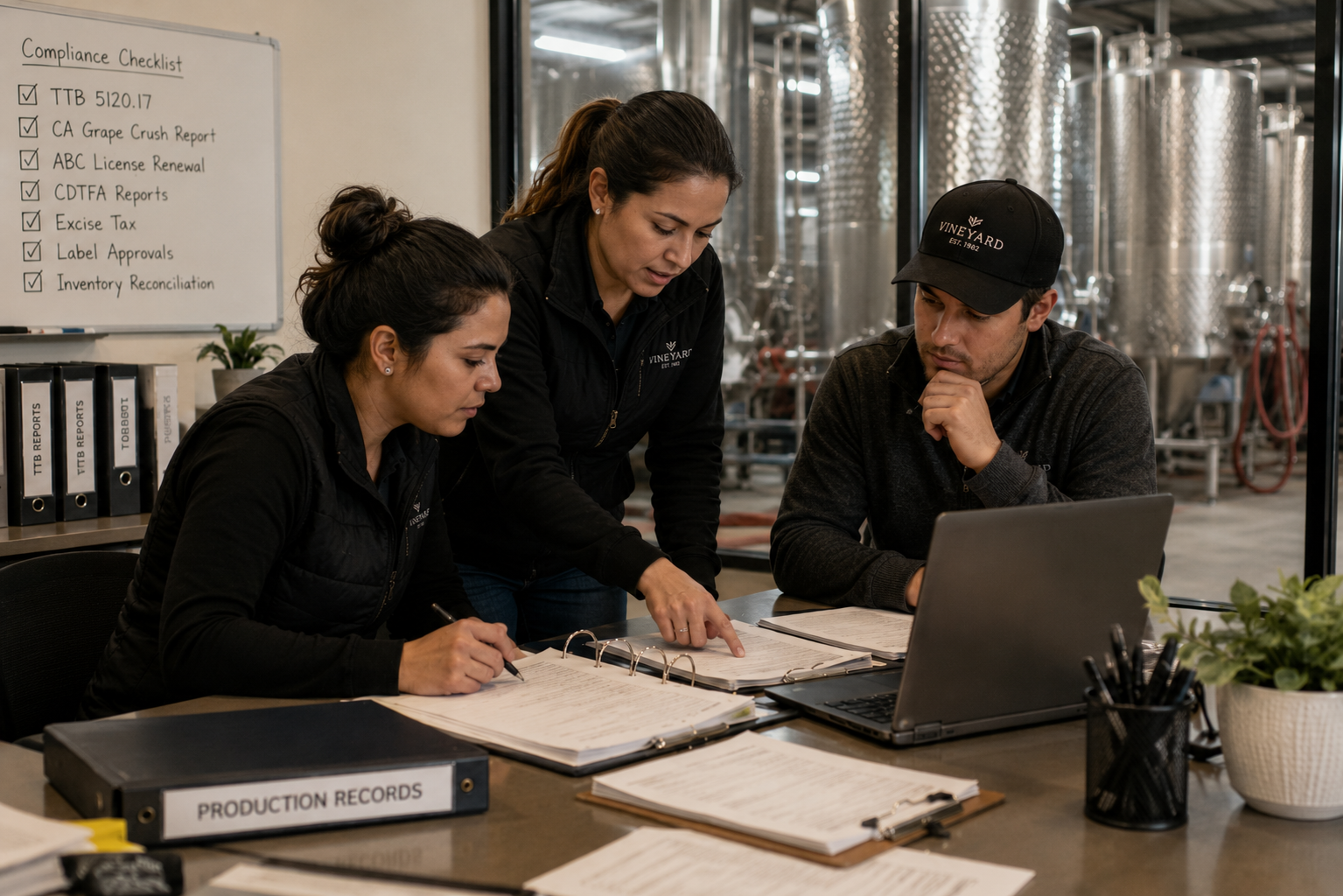
At many wineries, compliance knowledge is concentrated in one person.
That person knows when reports are due, where the supporting records are stored, how inventory discrepancies are handled and which production details need to be collected from the cellar. They may have developed the process over several years, often through experience rather than formal training.
The system can appear to be working well—until that employee goes on leave, changes roles or leaves the company.
Suddenly, another team member inherits a collection of reports, spreadsheets, passwords and deadlines without understanding how the pieces fit together. Even when previous filings are available, they may not explain why certain numbers were reported, where the information originated or which adjustments were made.
This is not necessarily an employee problem. It is a process problem.
A strong compliance program should be understandable, documented and transferable. The winery should know:
Which reports and renewals apply to the business
When each filing is due
Who is responsible for preparing and approving it
Where the underlying numbers are generated
Which records support each entry
How one filing connects to other reports and tax returns
What steps should be followed when something does not reconcile
Documenting these procedures protects more than the winery’s compliance status. It reduces interruptions, makes employee transitions easier and gives managers greater confidence in the information being submitted.
Cross-training is equally valuable. Compliance often depends on information from several departments, including production, accounting, administration and management. When each department understands how its work affects the winery’s records, errors are easier to prevent and questions can be resolved before a deadline is approaching.
This does not mean every employee needs to become a compliance expert. It means the winery should have a repeatable process that does not depend entirely on one person’s memory.
A useful place to begin is by reviewing the winery’s recurring reports and identifying where each number comes from. From there, teams can create written procedures, assign responsibilities, organize supporting records and establish a regular reconciliation schedule.
Wine Compliance Alliance provides customized winery compliance training based on a company’s specific operations, staff responsibilities and reporting needs. Whether a winery is training a new employee, preparing for a transition or strengthening an existing process, the goal is to help the team understand not only what must be filed, but how and why the information connects.
Learn more at winecompliancealliance.com.
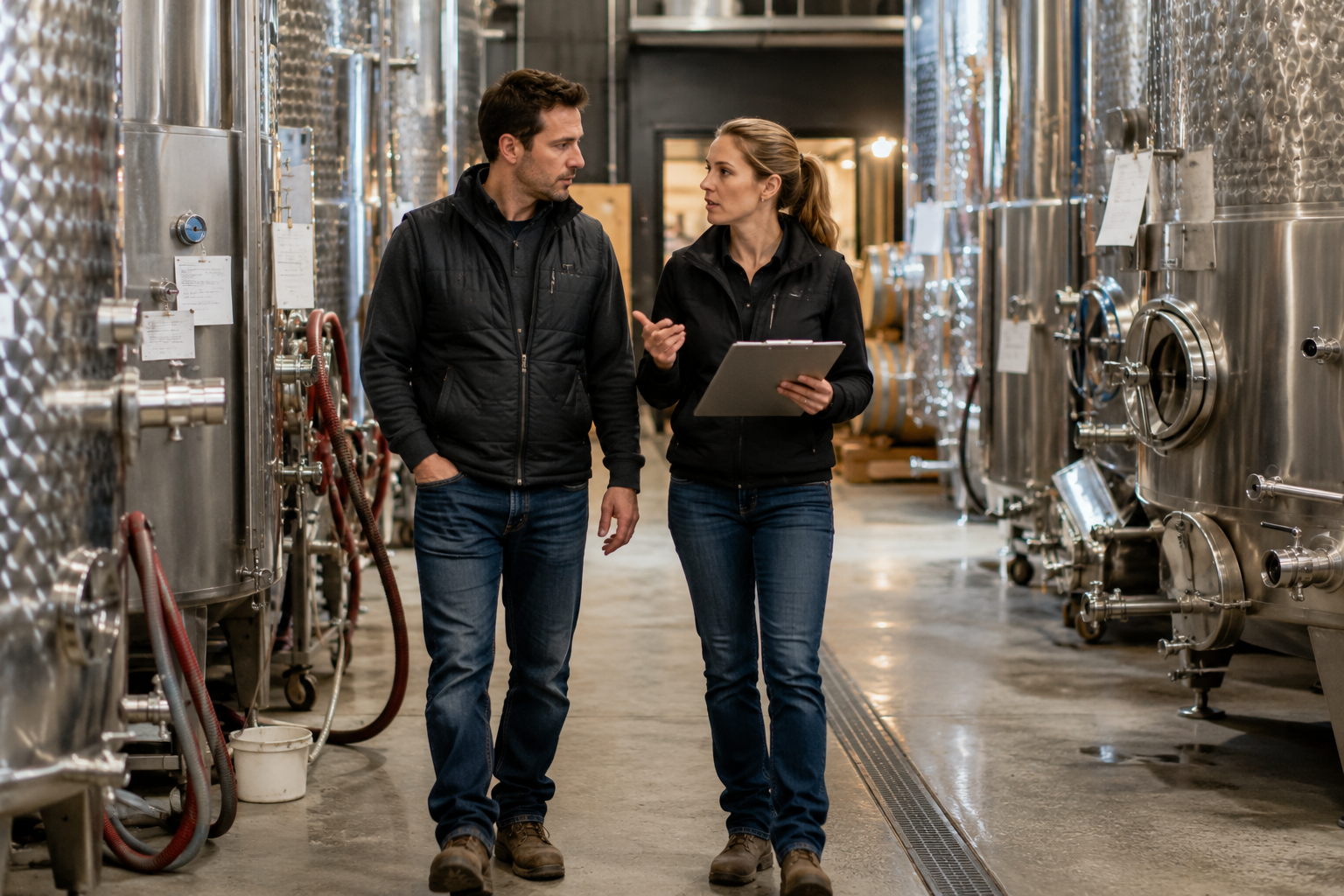
For a new wine brand, deciding where and how the wine will be produced is one of the first major operational choices. Two commonly discussed options are working as a custom-crush client or becoming an Alternating Proprietor, often referred to as an AP.Although both arrangements allow a brand to produce wine at another winery’s facility, they do not carry the same compliance responsibilities.
In a traditional custom-crush arrangement, the host winery generally produces the wine on behalf of the client. The wine remains within the host winery’s bonded premises and is recorded on the host’s winery reports. The client owns the brand and finished product, but the host winery is typically responsible for the federal production records associated with making the wine.
An Alternating Proprietor operates differently. An AP is separately permitted as a winery and temporarily shares space and equipment within a host facility. While using the same physical location, the AP operates under its own federal permit and is responsible for maintaining its own winery records, filing its own operational reports and meeting the compliance requirements that apply to its business.
Becoming an AP can provide greater independence and control, but it also comes with responsibilities that new brand owners do not always anticipate.
Before selecting a structure, consider questions such as:
Who will hold title to the wine while it is being produced?
Who will maintain the production and inventory records?
Who will file the required winery reports?
Who will calculate and pay federal excise tax?
Which business will appear as the producer or bottler on the label?
Does the brand have the staff or outside support needed to manage ongoing compliance?
The right answer depends on the brand’s goals, production plan, staffing and desired level of control. Neither structure is automatically better. The important thing is understanding the operational and compliance differences before permits are filed, contracts are signed or production begins.
A business structure that works during the first vintage may also need to change as the brand grows. Increased production, new investors, additional locations or a desire for greater independence can all affect the decision.
Wine Compliance Alliance works with new and established wine businesses to navigate winery permitting, Alternating Proprietor applications and ongoing production compliance. We also provide customized training to help winery owners understand the responsibilities associated with the structure they choose.
Learn more at winecompliancealliance.com.
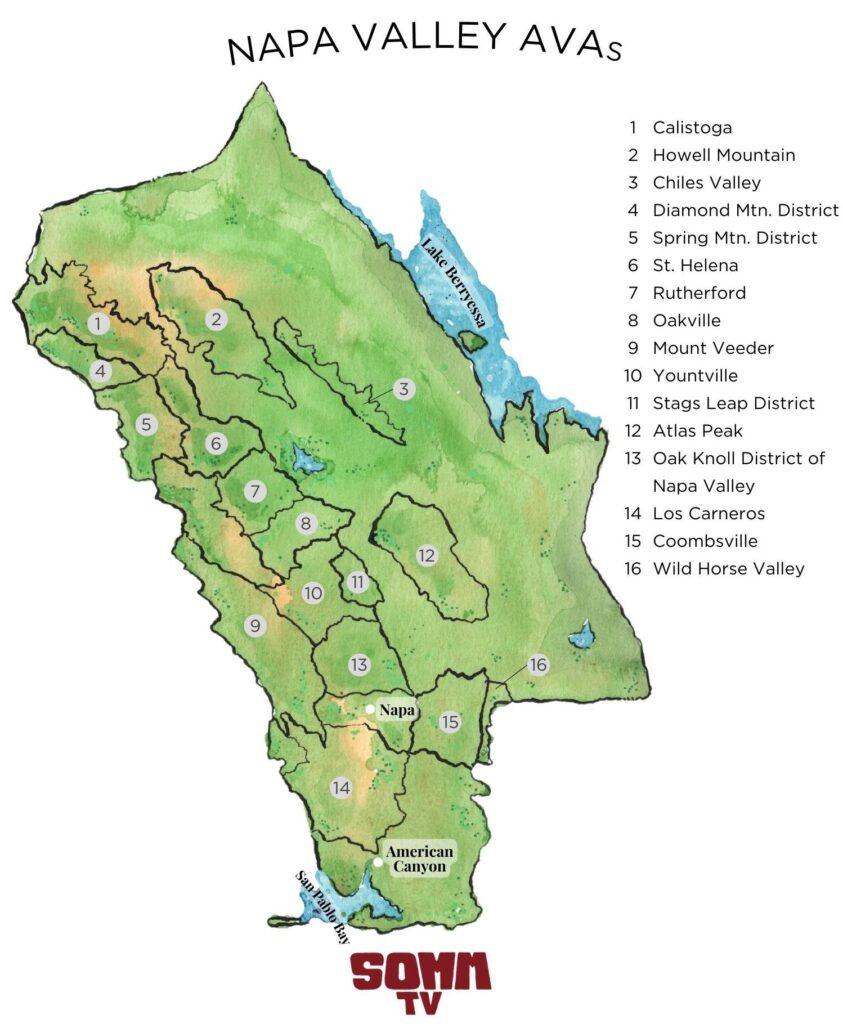
“Napa” is one of the most recognizable and valuable names in the wine industry—but using it on a wine label or in advertising is not simply a marketing decision.
Federal regulations and California law determine when a wine can use Napa, Napa Valley or one of Napa Valley’s sub-appellations. The requirements can also change depending on whether Napa appears as an appellation, within a brand name or elsewhere on the label.
Before submitting a label for approval or publishing advertising, winery teams should be able to answer questions such as:
Does the wine contain enough Napa Valley fruit to use the appellation?
Does it qualify to list a Napa Valley sub-AVA such as Oakville or Calistoga?
Can Napa appear in a brand name when the wine is not made from Napa grapes?
Can Napa appear elsewhere on the label?
Can more than one county be used as the appellation?
When does California law require “Napa Valley” to appear?
Do the federal and state requirements overlap?
Wine Compliance Alliance created When Does a Wine Qualify for Napa? to help winery professionals understand the rules before a label is submitted, printed or promoted.
The self-paced course explains which federal and California agencies regulate the use of Napa on wine labels and advertising. Participants learn the federal requirements for using Napa within a wine brand name, the minimum percentages associated with different types of appellations and the California laws that create additional requirements for Napa wines.
The course also uses examples of different wine blends to demonstrate why some wines qualify to use Napa designations while others do not.
Enrollment includes:
Detailed instructional videos
Examples of blends that qualify for Napa appellations
Examples of blends that do not qualify
Four quizzes to reinforce the material
Four downloadable handouts
The opportunity to submit questions
Lifetime access to the course
The training is particularly valuable for compliance employees, label coordinators, marketing professionals, winemakers and anyone responsible for submitting labels to the TTB.
Understanding the requirements before label development begins can help wineries avoid rejected applications, expensive label changes and advertising language that does not comply with the law.
Enroll in When Does a Wine Qualify for Napa? for a one-time payment of $475 and gain lifetime access to a practical resource your team can consult whenever a Napa-related label or marketing question arises.
Learn more and enroll through the Winery Compliance Training Academy at winecompliancealliance.com/training.
California wineries and CA wine businesses are required to hold certain licenses with the CDFA, the CA Dept of Food & Ag. This video explains what those two licenses are and who is required to hold them.
With harvest well underway wineries across the country have already finished fermenting many new 2026 wines. At this stage in the winemaking process is when "Produced by fermentation" is reported. That's a TTB term which comes directly from a line on the TTB Report of Wine Premise Operations. (5120.17 or the Old form # 702) Listing gallons as "produced by fermentation" gives a couple of key benefits to wineries, as pointed out in the short video. Go HERE for more info on our TTB harvest compliance training course.
California wineries and CA wine businesses are required to hold certain licenses with the CDFA, the CA Dept of Food & Ag. This video explains what those two licenses are and who is required to hold them.
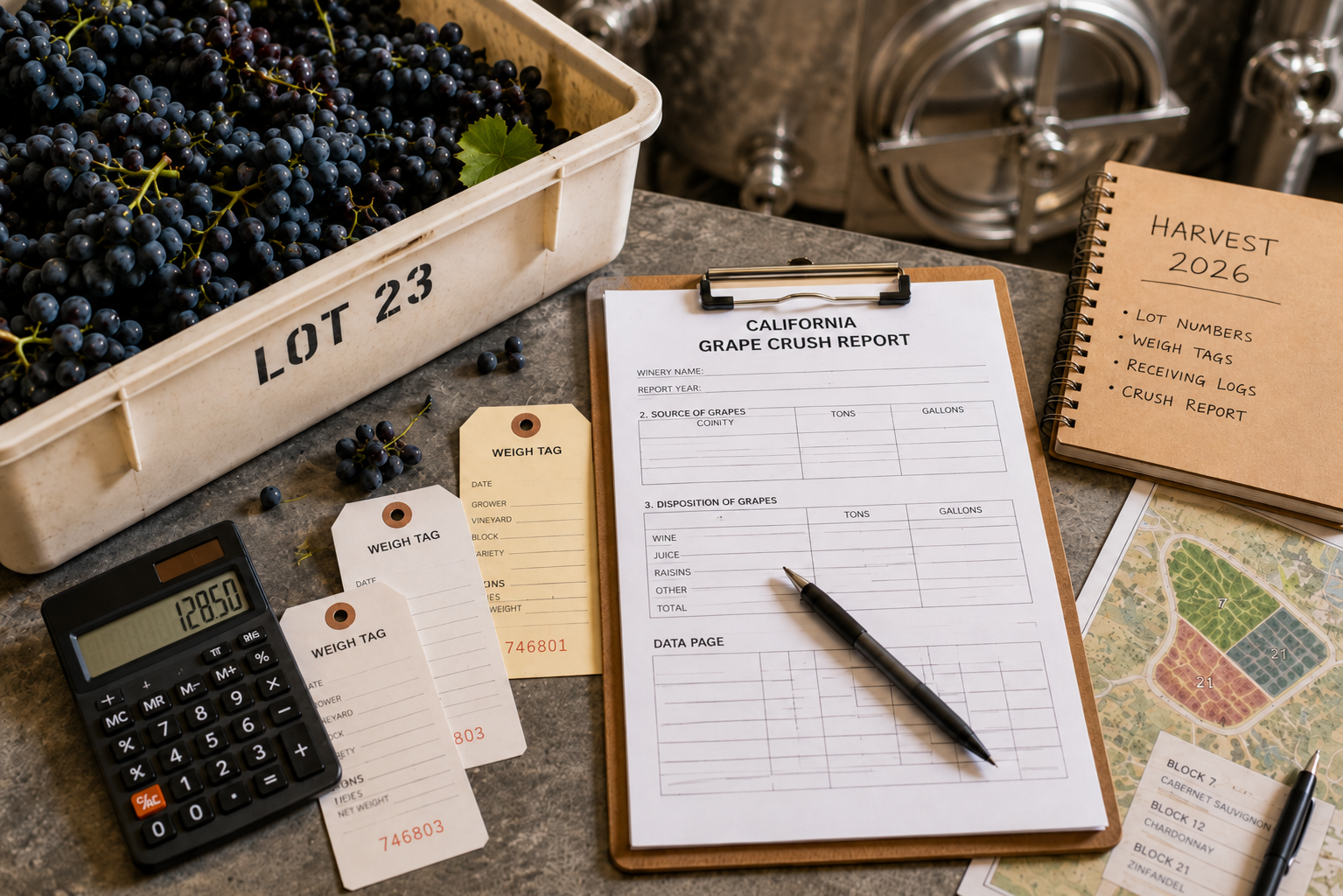
The California Grape Crush Report is only filed once a year—but the information needed to complete it correctly is generated throughout harvest.
By the time the filing deadline arrives, winery employees may be sorting through weigh tags, grower information, grape purchases, custom-crush activity and production records while also trying to determine which version of the report their business is required to use.
A few common questions can quickly become major sources of confusion:
Is our wine business required to file?
Do we qualify to use the EZ Report?
Which grape transactions need to be included?
How should our information be organized before we begin?
What belongs in Questions 2 and 3?
How should the Data Page be completed?
Are we making one of the reporting mistakes that commonly causes problems?
Wine Compliance Alliance created The Do’s and Don’ts for Filing the California Grape Crush Report to help California wine businesses approach the report with a clearer process and greater confidence.
This recorded training walks participants through who is required to file, how to determine whether the original or EZ version applies and how to prepare grape information before entering it into the report.
The training also includes practical examples demonstrating how to complete Questions 2 and 3 and the Data Page, along with five of the most common mistakes Wine Compliance Alliance sees and guidance for avoiding them.
Most importantly, this is not a one-time live presentation that disappears after the filing season ends. The recording can be saved and revisited during future annual filings, making it a valuable training resource for both current employees and anyone who may inherit the responsibility later.
The course is especially useful for:
Winery compliance and administrative employees
Controllers and accounting staff
Winemakers responsible for production records
Custom-crush facilities
Alternating Proprietors
Employees completing the report for the first time
Experienced filers who want to confirm their process
Getting organized before beginning the Grape Crush Report can save time, reduce corrections and make the annual filing far less stressful.
Purchase The Do’s and Don’ts for Filing the California Grape Crush Report recorded webinar for a one-time payment of $100 and keep it available as a resource for future filing years.
Learn more and purchase the training through the Winery Compliance Training Academy at winecompliancealliance.com/training.
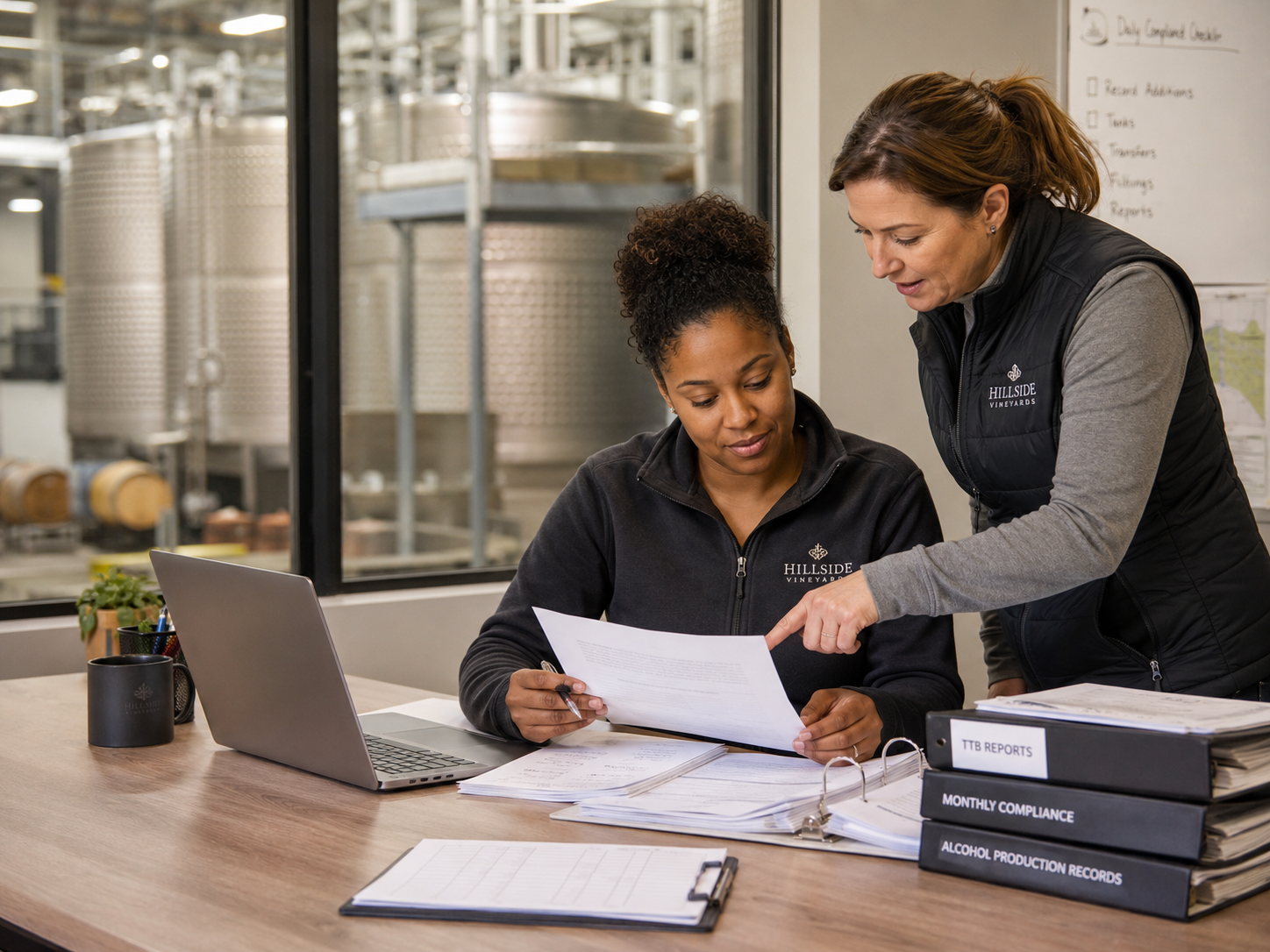
Winery compliance reports are often treated as an administrative task—something completed in the office after the production work is done. In reality, accurate reporting begins much earlier, with the records created on the cellar floor.
Every time grapes are received, wine is transferred, material is added, inventory is bottled or product leaves the winery, that activity becomes part of the winery’s compliance story. If the supporting records are incomplete, unclear or inconsistent, the problem will eventually surface when it is time to prepare operational reports, calculate excise tax or reconcile inventory.
This is why correcting a report alone does not always solve the underlying issue. A winery may be able to adjust a number on one filing, but that same number could affect several other records and reports. Beginning inventory must agree with the previous reporting period. Production activity must be supported by cellar records. Taxpaid removals must align with excise-tax filings. Bonded inventory should match what the winery can physically account for.
When those pieces do not connect, winery teams can spend hours trying to reconstruct what happened months earlier.
A more reliable compliance process begins with a few practical habits:
- Record production activity consistently and as it occurs.
- Use clear terminology across cellar, accounting and compliance teams.
- Reconcile inventory regularly rather than waiting until year-end.
- Keep supporting documentation organized and accessible.
- Review reports together instead of treating each filing as an isolated task.
Communication is especially important when compliance responsibilities are divided among several people. A winemaker may understand the physical movement of the wine, while a controller manages tax payments and an administrator prepares reports. Each person may be completing their part correctly, but the final filings can still be inaccurate if the information is not being shared.
The goal is not simply to submit a report by the deadline. It is to create a recordkeeping system that accurately reflects what happened inside the winery and supports every number being reported.
Wine Compliance Alliance helps wineries connect day-to-day production activity with the records and filings it creates. Through customized training and ongoing production report management, we help winery teams understand where their numbers come from, how reports relate to one another and how to identify potential gaps before they become larger problems.
Learn more at winecompliancealliance.com.
Every U.S. winery has federal reporting responsibilities—but knowing exactly which TTB reports apply to your operation, when they must be filed and how to complete them correctly is not always straightforward.
For many winery employees, compliance is only one part of an already demanding job. You may have inherited the responsibility from someone else, learned by reviewing past filings or simply done your best to piece together guidance from different TTB resources.
That can leave you wondering:
Are we filing every report that applies to our winery?
Are we using the correct filing frequency?
Is our TTB 5120.17 being completed correctly?
Do we have the proper signing authority on file?
Are we calculating our excise-tax credits accurately?
Does this wine require a label approval?
Do our labels include all legally required information?
The Winery Compliance Training Academy created The TTB Reports All U.S. Wineries Are Required to File to give winery professionals a practical introduction to these essential federal requirements.
The self-paced course explains the three primary reports U.S. wineries may be required to file, when each report applies and which TTB platforms are used to submit them. It also covers common mistakes made on the TTB 5120.17, signing authority, excise-tax credits, mandatory wine-label information and when a Certificate of Label Approval may be required.
Rather than simply directing you to a regulation or government webpage, the course walks through these subjects in clear, winery-specific language.
Enrollment includes:
12 instructional videos
Two downloadable handouts
Links to helpful TTB resources
Practical explanations of filing requirements
The opportunity to submit your own questions
Lifetime access to revisit the material whenever needed
This course is a valuable resource for employees who are new to winery compliance, professionals who have been filing reports but want greater confidence, and winery owners who want to better understand their federal responsibilities.
You should not have to wonder whether you are completing your winery’s most important federal filings correctly.
Enroll in The TTB Reports All U.S. Wineries Are Required to File for $397 and gain lifetime access to practical compliance training created specifically for winery professionals.
Learn more and enroll through the Winery Compliance Training Academy at winecompliancealliance.com/training.
My thanks to winemaker and podcaster Jim Duane for being willing to be the interviewee this time. We met in 2016 when I was a guest on his podcast talking about my book. In this interview we talked about his story getting into winemaking, moving to Napa, starting a podcast (Inside Winemaking) in 2014 and going through a TTB audit.