


When accounting firms talk about experience, they usually do the same thing. They add up every team member’s total career years and put the biggest number they can find on the website.We wanted to do something more conservative and, I think, more honest. We counted only the time our team has spent here at Protea, doing wine and beverage accounting for our clients.
That number is 205 years.
It’s shared across our 38-person accounting and client service team, with accountants in Gqeberha and client service managers in the US. On average, each person has been with Protea for more than five years:
Seven have been here more than a decade.
Sixteen have been here more than five years.
Nearly two-thirds have been here more than four years.
And 205 years is a floor, not a ceiling. It doesn’t include the wine industry experience many of our team brought, so our real wine experience is higher. It also doesn’t include the years they spent in accounting, audit, and finance before joining us, so our accounting experience is even higher.
Why tenure matters more in wine than almost anywhere else
Most businesses run on a twelve-month cycle that a capable accountant can learn in a quarter or two. Wine doesn’t work that way.
A winery’s financial year is shaped by harvest. Costs flow through grapes, bulk wine, barrels, and bottling before they ever become case goods, and some of that inventory sits for years before it’s sold. Then there’s excise reporting, wine club runs, DTC versus wholesale margins, and the realities of three-tier distribution. Getting these right isn’t about knowing the rules. It’s about seeing how they play out across many vintages and wineries.
You only build that judgment one harvest at a time. Every year someone spends at Protea is another harvest costed, another year-end inventory closed, and another set of client questions they’ve already worked through once. That experience compounds, and you can’t shortcut it.
There’s a wider industry reason this matters too. The accounting profession is facing a well-documented talent shortage, and turnover is a fact of life at many firms. For a client, that often means a new person on your books every year or two, along with the cost of explaining your business all over again. We’ve deliberately built Protea to be a place people stay, and the numbers above show it.
What this means for the businesses we work with
Experience matters only if it makes a difference for our clients. Here’s where it does.
You stop re-teaching your business. When the team that learned your operation is still the team running it, you aren’t spending each year onboarding a new accountant into your cost structure, blending decisions, or wine club quirks.
Institutional memory stays intact. Why did you change your overhead allocation three years ago? Why is that bulk lot valued the way it is? On a long-tenured team, someone remembers. That continuity protects the consistency of your numbers year after year, which matters to your lenders, your auditors, and your own decision-making.
Harvest and year-end are less painful. The busiest, highest-stakes periods are where experience shows most. People who’ve lived through many harvests know what to expect, what usually goes wrong, and what needs attention early.
You get pattern recognition, not just bookkeeping. Our team has seen how many wineries handle the same challenges: DTC channel costs, inventory build-up, pricing pressure, growth funding. That perspective turns your monthly close into a conversation about what’s working and what isn’t, not just a set of reports.
You build a relationship, not a vendor arrangement. Trust comes from time. Clients tell us they value knowing the people on their account and knowing they’ll still be there next year.
The number behind the number
I’m proud of 205 years. But what I’m really proud of is what it says about the people here. They’ve chosen to build their careers at Protea, and they’ve chosen to get very good at one industry. That commitment benefits our clients every month.
Put 205 years to work for your winery.
If you’re looking for an accounting team that already understands wine and plans to stick around, I’d love to talk. Send me a message or book a time through our website.

A few years ago, we took on a winery that knew exactly which wine paid the bills. It was their volume SKU. 3,500 cases a year into distribution, the label everyone in the market recognized, the one the rest of the portfolio leaned on.
We ran the numbers. They lost money on every single case they sold.
They weren't careless. They had a CFO at the time. They knew their gross margin was healthy, right around 40%. Nobody had ever asked what it cost them to make those sales.
That number has a name, and it is the one I want more winery owners looking at.
What contribution margin actually is
Gross margin tells you what's left after the cost of the wine in the bottle. Contribution margin tells you what's left after the cost of the wine and everything you spent to move it.
Sales, less cost of goods sold, less the costs to actually make the sale.
That last part is where it all lives. Billbacks and depletion allowances. Freight. Samples and POS. Commissions. The salaries of the people doing the selling. Credit card fees. The shipping you quietly subsidize. The staff hours on the tasting room floor.
Gross margin is a production number. Contribution margin is a business number.
Two channels can have identical gross margins yet completely different economics because one costs three times as much to serve. Gross margin will never show you that. Contribution margin is the only view that puts your channels on the same footing and lets you rank them honestly.
What it looked like for that winery
Here is roughly what we found on that 3,500-case SKU. The numbers are rounded, but the shape is real.
Per case into distribution:
Revenue — $120 Cost of goods sold — $72 Gross margin — $48, or 40%
We feel good about this. And a lot of the time, that's where the conversation stops.
Now let's look at the rest:
Billbacks and discounts — $30 Freight — $8 Allocated sales salaries — $20 Total cost to make the sale — $58
Contribution margin: negative $10 per case.
Across 3,500 cases, that's $35,000 walking out the door on their supposed hero SKU, before a single dollar of overhead.
The billback line is what got them. When we asked how their billbacks were going, they said, "Not too bad."
They were giving away the equivalent of three bottles with every case they sold.
And they had good reasons for every one of those programs. They were chasing shelf placement in the best sell-through grocery stores in their markets, which is exactly where you want your volume SKU to be. Each program was defensible on its own. Nobody ever added them up. Because the total never appeared as a cost, it never appeared in anyone's thinking.
That's the pattern. It's seldom one catastrophic number. It's four or five ordinary ones that nobody added up.
Now do it for your DTC channels
This is where it gets genuinely useful for most wineries, because DTC isn't one channel. It's four or five wearing the same name.
Start with DTC as a whole, then split it. Tasting room. Online. Club or subscription. Events. Retail. Run contribution margin on each one separately, and you will find they look nothing alike.
Events are the clearest example. On the East Coast especially, where you have to compete hard to get people through the door, live music and ticketed events are a real part of the business model. Run the contribution margin on those events, and it very often comes back negative.
That may be completely fine. Getting people in the door is your entrance price. The question is what happens once they're inside. How much wine moves during the event? How many of those people convert to club members with recurring revenue and a long lifetime value?
So the rule I'd offer is this: a channel that loses money can absolutely earn its place, but only if you can name the channel it feeds and the rate at which it converts. If you can't name both, you don't have a strategy; you have a habit.
And if a channel is deeply negative, no amount of strategic storytelling fixes it. Contribution margin can't be the only input to the decision. But it has to come first.
Where to start
You don't need a new system for this. You need revenue and case equivalents by channel, discounts by channel, fulfillment and tasting room payroll, shipping cost and how much of it you passed on, and a COGS number you actually trust.
Reach out to your accountant this week and ask them to build out contribution margin by channel. If they can't, or your system won't support it, that's worth knowing too.
At Protea Financial, we do this work for wineries every week: SKU-level costing, channel-level contribution margin, and the uncomfortable conversation that usually follows. If you've never seen your business cut this way, I'd genuinely like to show you what it looks like.

Winery accounting has a way of becoming more complicated without anyone formally deciding that it should.
A winery grows. Production increases. DTC becomes a larger part of the business. Wholesale expands into additional markets. Inventory becomes more significant. Reporting expectations increase. And yet the accounting function may still depend on the same person, or the same basic processes, that worked when the business was much smaller.
That can work for a surprisingly long time.
Until it doesn't.
The challenge is not necessarily that a winery has hired the wrong accountant or bookkeeper. More often than not, the accounting structure has not kept pace with the complexity of the business.
Winery Accounting Is Different
Wine businesses face accounting challenges that are not found in many other industries.
Inventory can remain on the balance sheet for years before being sold. Costs move through farming, production, aging, bottling, and finished goods. Bulk wine has to be reconciled into bottled inventory. Revenue and margins may need to be understood across tasting room, wine club, ecommerce, wholesale, and distributor channels.
Add compliance requirements, distributor activity, depletion information, and harvest seasonality, and the accounting function becomes an important part of understanding how the business is actually performing.
That requires more than simply recording transactions correctly.
It requires processes, documentation, review, and an understanding of how winery operations ultimately flow through the financial statements.
The Risk of Relying on One Person
Many wineries rely heavily on one bookkeeper, accountant, controller, or office manager who has accumulated years of institutional knowledge.
That person may know which reports need to be run, how inventory reconciliations work, where unusual transactions should be recorded, and what needs to happen during month-end close.
The problem is that much of that knowledge may exist only in that individual's head.
Vacations can delay work. Turnover can create disruption. A departure can leave the winery trying to reconstruct processes that were never properly documented.
The issue is not the individual's quality. Even an exceptional employee can become a single point of failure when there is no backup, a review process, or a documented system for the role.
Temporary Help Has Its Limits
When accounting capacity becomes stretched, wineries frequently respond by adding temporary or general accounting support.
That may solve an immediate workload problem.
Someone can process bills, complete reconciliations, enter transactions, or help get the books caught up.
But adding capacity does not automatically add winery expertise.
A competent accountant entering the wine industry still needs time to understand inventory flows, cost allocations, channel reporting, distributor activity, and the operational realities behind the numbers.
There is nothing wrong with learning those skills. The question is whether the winery has the time, documentation, and internal support necessary for that learning process.
Simply filling a seat does not necessarily solve the underlying structural problem.
What a Stronger Accounting Function Looks Like
As wineries grow, the objective should be to build an accounting function that is less dependent on individuals and more dependent on repeatable processes.
That usually means several things.
Important procedures should be documented rather than relying on institutional memory. Someone should be able to step in when another team member is unavailable. Month-end reconciliations and financial reporting should include an appropriate level of review. And the people responsible for winery-specific accounting areas should understand the underlying business activity.
The accounting structure should also align with the winery's size and needs.
Not every winery needs a full accounting department or a full-time controller. Some need additional bookkeeping capacity. Others need stronger month-end oversight, better inventory accounting, or more reliable financial reporting.
The goal is not necessarily to add more people.
It is to build sufficient structure, expertise, and redundancy so that the accounting function can consistently support the business.
A Useful Question for Winery Leaders
Instead of asking, "Do we need another accountant?" winery owners and operators may benefit from asking a different question:
Has our accounting function grown with the rest of the winery?
If the answer is no, the next step may be less about filling another position and more about examining the systems, knowledge, oversight, and support surrounding the accounting function.
Because as a winery becomes more complex, its accounting infrastructure eventually has to evolve with it.
The wine industry is facing no shortage of pressure. Demand is softer, costs remain high, tasting-room traffic is less predictable, and excess inventory continues to consume cash.
InnoVint’s 2026 State of Winery Health Report looks beyond those challenges and asks a practical question:
Why are some wineries performing well while others facing similar conditions are struggling?
Based on responses from 541 winery professionals, the report evaluates financial, operational, and cultural health. Its central finding is that winery health depends less on location, size, or sales channel than many might expect. What matters most is how the business is managed.
Financial Health Is the Weakest Link
Only 42% of wineries rate their overall business health as good or excellent. In comparison, just 40% say the same about their financial health.
Operations and culture remain stronger. Sixty-two percent describe their operations as good or excellent, and 69% rate their culture as great or exceptional.
That suggests many wineries still have capable teams and functional operations, but their financial foundations are under strain.
Sales remain the biggest concern, cited by 80% of respondents. Tasting-room traffic, rising production costs, excess inventory, and competition from other brands and beverage categories also ranked highly.
All of these pressures are closely connected. Slower sales create excess inventory. Inventory ties up working capital and increases storage costs. Pressure to move wine can lead to discounting, which can further weaken margins. It is a vicious cycle wineries operate in.
Five Habits of Healthy Wineries
InnoVint identified five habits that separate healthier wineries from struggling businesses.
First, they run lean and protect profitability. Seventy-three percent of healthy wineries are profitable, compared with only 21% of struggling wineries.
One finding is particularly important: wineries with flat sales are profitable almost as often as growing wineries—57% compared with 58%. That challenges the assumption that growth alone will solve a winery’s problems. Growth without operational discipline can create more inventory, complexity, and working-capital pressure.
Second, healthy wineries understand what each wine earns. Forty-three percent of wineries still make pricing and discounting decisions without knowing the margin effect on each SKU. Even among wineries confident in their pricing, many do not know the true production cost or profit per bottle.
Revenue is great, but alone it does not identify a winery’s strongest products. Better decisions require accurate costing, SKU-level profitability, channel margins, and visibility into the impact of discounts. Clear and accurate margin data makes a big difference.
Third, healthy wineries operate connected systems. Fifty-nine percent of respondents said inefficiencies are costing them money, often because their production, inventory, sales, and accounting systems do not communicate effectively.
When teams rely on disconnected spreadsheets and duplicate data entry, reporting slows down, and errors become more likely.
Fourth, they invest in culture. Wineries with strong cultures report better employee satisfaction, healthier operations, lower turnover, and stronger financial performance. Culture is not separate from execution. It affects communication, accountability, and the speed at which problems are identified.
Finally, healthy wineries participate in their communities. Wineries deeply involved in local and industry networks were more than twice as likely to describe themselves as healthy overall: 60% compared with 29% among minimally involved wineries.
Turning the Findings Into Action
The report points toward several practical priorities:
Calculate the true cost and profit of every wine.
Review pricing and discounts against margin.
Align production with realistic demand.
Improve cash flow and inventory forecasting.
Connect financial, production, sales, and inventory information.
Select one measurable operational improvement each quarter.
The broader market remains difficult, and individual wineries cannot control consumer demand or distributor consolidation.
They can control the quality of their costing, systems, forecasting, communication, and decisions.
That may be the report’s most useful conclusion: healthier wineries are not waiting for conditions to improve. They are managing more deliberately with the information they have today.
For deeper analysis, read more here.

The 2026 SVB Direct-to-Consumer Wine Report delivers a message that every winery owner and operator should pay attention to.
The headline isn't that visitation is down. Most wineries already know that.
The headline isn't that wine club growth has slowed. Most wineries are experiencing that reality as well.
The real story is that while the median winery reported no growth, the top-performing quartile of wineries increased revenue by 22%, while the bottom quartile declined by 13%.
In other words, wineries are operating in the same market conditions but achieving dramatically different results.
So what separates the winners from the rest?
The Industry Challenges Remain
The report confirms several trends that continue to pressure winery profitability.
Direct-to-consumer sales remain the foundation of the premium wine business, accounting for approximately 72% of revenue. Yet the channels driving those sales are under strain.
Tasting room visitation continues to decline, reducing opportunities to acquire new customers and wine club members. At the same time, wine club growth has slowed as acquisition rates struggle to keep pace with attrition.
These challenges are real and unlikely to disappear overnight.
However, the report suggests that market conditions alone do not determine success.
The Key Difference: Customer Focus
Perhaps the most valuable insight from the report is the distinction between the mindset of high-performing wineries and struggling wineries.
According to SVB, successful wineries focus outward on customers and relationships.
Struggling wineries focus inward on operations and costs.
That distinction may sound simple, but it has significant implications.
The wineries achieving growth are investing time in understanding their customers, building stronger relationships, creating memorable experiences, and maintaining meaningful engagement beyond the tasting room.
Meanwhile, struggling wineries are more likely to focus on reducing expenses, lowering prices, improving operational efficiency, or upgrading facilities in the hope that customers will return.
Operational discipline is essential. Every winery should manage costs and maintain financial control.
But cost-cutting alone does not create demand.
Taking the Winery to the Customer
One of the most interesting themes throughout the report is the growing emphasis on meeting customers where they are.
Many of the highest-performing wineries are expanding engagement beyond the winery visit through regional events, wine dinners, club gatherings, community involvement, and direct customer outreach.
Rather than waiting for consumers to come to wine country, they are finding new ways to strengthen relationships in the markets where their customers live.
The wineries succeeding today appear to recognize that the future of direct-to-consumer sales extends beyond the tasting room.
What Winery Operators Should Do Next
The report points to several practical actions winery operators can take immediately:
Develop a deeper understanding of your customer base and segment customers based on behavior, not just demographics.
Focus as much attention on retention as acquisition.
Create opportunities to engage customers between club shipments and winery visits.
Evaluate customer lifetime value, conversion rates, and retention metrics alongside traditional sales measures.
Invest in relationship-building initiatives that strengthen customer loyalty and brand affinity.
The wineries growing today are not waiting for conditions to improve. They are adapting their strategies to match changing consumer behavior.
The Opportunity Ahead
The most encouraging takeaway from this year's report is that growth remains possible.
The data clearly shows that some wineries are finding ways to succeed despite declining visitation and changing consumer preferences. The difference is not simply the market they serve. It is how they respond to the market they are given.
At Protea Financial, we work exclusively with wineries to help them understand their numbers, identify opportunities, improve profitability, and make better business decisions. From operational accounting and cost accounting to financial reporting and winery-specific advisory services, our focus is on helping wineries turn information into action.
If you're looking to better understand your customer profitability, wine club performance, operational efficiency, or overall financial health, let's start a conversation. The wineries that thrive over the next decade will be those that combine strong financial management with a deep understanding of their customers.
The data is available. The opportunity is there. The question is whether your winery is positioned to take advantage of it.
Download the full report here.
Read more analysis here.
Need help with your numbers? Reach out.
The 2026 BMO Wine Market Report confirms what many winery owners have already been experiencing firsthand: the wine industry is no longer dealing with a temporary slowdown. It is operating through a structural reset.
While the U.S. wine market still surpassed $115 billion in total value in 2025, overall wine volume declined again, continuing a multi-year trend that is reshaping nearly every segment of the business. A worrying trend that continues to reshape the industry and shape perceptions of where the bottom could be. According to the report, changing demographics, affordability pressures, evolving consumer habits, distribution disruptions, and rising operating costs are converging.
For winery owners, the key takeaway is simple: the old assumptions no longer hold.
For years, much of the industry conversation centered around oversupply. Too many grapes, too much bulk wine, and too much inventory sitting in tanks and warehouses. While those issues remain very real, the BMO report makes it clear that the deeper challenge is weakening demand.
Total market volume declined another 4% in 2025 to 362 million cases, while still table wine volumes are now roughly 20% below 2018 levels. California shipments into the U.S. market have also fallen significantly from previous highs.
Demand-driven slowdowns create operational pressure across the entire business. Inventory moves slower. Cash conversion cycles lengthen. Forecasting becomes less predictable. Production planning carries greater risk. Margins become harder to defend. Overall pressure that, if not managed appropriately, would lead to people exiting the space.
At the same time, the report highlights a major demographic transition already underway. Baby Boomers, who largely fueled the premium wine boom over the past several decades, are drinking less as they age. Meanwhile, younger consumers have not adopted wine at the same rate as previous generations did.
What is important, however, is that the report does not suggest younger consumers dislike wine. In fact, many younger consumers express interest in drinking more wine. The challenge is conversion and consistency.
Wine is now competing in a dramatically different marketplace. And they are struggling to win. RTD cocktails, hard seltzers, cannabis beverages, hemp-derived THC drinks, and countless alternative lifestyle choices are competing for the same discretionary spending. Many younger consumers also continue to view wine as expensive, intimidating, or overly complicated compared to those alternatives.
Premiumization alone is unlikely to solve this challenge moving forward.
The report also repeatedly highlights affordability as a growing issue. Inflation, higher housing costs, student loan repayments, and broader economic uncertainty have changed how consumers make purchasing decisions. At the same time, wineries continue facing rising costs for labor, glass, freight, and fulfillment.
This creates margin pressure from both sides.
Operationally, that means wineries need far more precision than they did during the growth years. Understanding true SKU profitability, inventory carrying costs, channel margins, and customer acquisition costs is becoming increasingly important in a slower-growth market.
Direct-to-consumer remains one of the strongest opportunities for wineries, particularly those with premium positioning and strong customer relationships. According to the report, 50% of wineries surveyed still expect DTC growth this year. It will be interesting to see if they are actually able to achieve these goals.
But the DTC environment has changed as well.
Shipment volume has fallen significantly from pandemic highs, shipping costs continue to rise, and lower-priced wines are becoming more difficult to sell profitably through fulfillment channels. The easy years of DTC growth appear to be over. Success today depends much more heavily on customer retention, hospitality quality, operational discipline, and consistent communication.
The report also points to growing disruption in the wholesale tier, highlighted by RNDC’s exit from California. More wineries are reporting reduced distributor support and taking on greater responsibility for account management and market development themselves.
Route-to-market strategy now matters more than ever.
Perhaps the most important message in the report is that industry consolidation is likely to continue. Total U.S. wine market volume is roughly back to 2012 levels, yet the number of wineries is nearly 50% larger than it was then.
That reality will create both challenges and opportunities.
The wineries most likely to succeed through this next phase of the market will not necessarily be the largest. They will be the ones with operational discipline, financial visibility, strong customer relationships, and the ability to adapt quickly to changing market conditions.
For winery owners, operational clarity is no longer just a financial management tool. It is becoming a competitive advantage.
Download the full report here.
If you need help understanding your costs and forecasting for the future, reach out.
The release of the latest report from Azur Associates provides one of the clearest assessments of the current state of the wine industry. The report’s message is direct: this is not simply a temporary slowdown or another cycle the industry can wait out. The market is undergoing a structural reset.That perspective aligns with much of the data we have seen from Silicon Valley Bank, Rabobank, and other industry sources over the past few years. Demand has softened, inventory levels have increased, and younger consumers are approaching alcohol very differently from previous generations. However, where Azur stands apart is in its interpretation of what these trends actually mean for the future of wine.
The report makes a strong case that the industry is moving toward a much smaller, significantly more competitive market. Consumption patterns have changed, and the assumptions that supported growth for decades are no longer reliable or realistic. Consumers are drinking less frequently, exploring alternative beverage categories, and placing greater importance on value, convenience, and occasion. Consumption habits are just different! Wine is no longer competing only within its own category. It is competing against a broader range of beverage options that often align more closely with current consumer habits.
One of the most significant challenges highlighted in the report is distribution compression. This has been a growing problem, but it is spreading. Both off-premise and on-premise channels are becoming increasingly competitive. Retailers are reducing SKUs for other beverages or products, distributors are becoming more selective because placements are so much harder, and it is leaving many brands struggling to maintain visibility. All of this is happening and at the same time, ready-to-drink beverages and spirits continue gaining share in on-premise environments. This creates additional pressure on wineries already dealing with slowing sales velocity and changing consumer behavior.
The report goes into the touchy subject of exits. IT highlights the changing landscape for valuations and mergers and acquisitions. It is not pretty. Transactions are still occurring, but the market has shifted significantly. Buyers have become more disciplined, capital is more selective (it is a lot more expensive at the moment), and many deals are being driven by strategic exits or financial pressure (which creates downward price pressure). The days of broad optimism and aggressive expansion appear to be behind us for now. Instead, the industry is entering a period where operational discipline and strategic clarity matter more than ever.
One of the more practical elements of the report is Azur’s focus on what it calls the “Four F’s”: Format, Function, Flavor, and Financial value. These concepts center around better alignment with today’s consumer. Packaging, accessibility, occasion-based marketing, evolving taste preferences, and clear value propositions are becoming increasingly important. Wineries can no longer assume that legacy positioning or historical success will carry them forward.
While much of the report is direct about the industry's challenges, and rightfully so, it is important not to interpret the outlook as entirely negative. There are still opportunities for well-run businesses with strong leadership and a willingness to adapt. However, success is likely to look different from what it did in previous decades. Growth will require sharper decision-making, stronger financial oversight, and a clearer understanding of market realities.
From my perspective, one of the most valuable aspects of this report is its honesty. Many in the industry have recognized these trends for some time, but Azur brings them together into a clear narrative about where the market is heading. The wine industry is not disappearing, but it is changing rapidly. Businesses that recognize that shift early and make intentional adjustments will be in a far stronger position moving forward.
At Protea Financial, we continue to work closely with wineries as they navigate these challenges every day. The businesses that succeed in this next phase of the market will be the ones that combine strong operational discipline with the ability to adapt to a changing consumer and distribution environment.
Access the full report here - https://www.azur-associates.com/azurintelligencetest/2026ytd
For a more detailed view of the Azur Associates report, read more here.
For a look at the SVB 2026 State of the US Wine Industry, read more here.

Oh sure, there’s a ton of romance and history in the origins of winemaking.
And every boutique enterprise, no matter how large or small, has a charming tale to tell about their artisan craft and how it all got started.
But at the end of the day, wineries live or die by their numbers
No matter how compelling the story or how good the wine, if the numbers don’t work, the business is bound to fail.
To avoid that, it’s imperative for wineries to have rock-solid data on their day-to-day fiscal operations so they’re able to determine the overall health of their organization.
That’s where having the right financial infrastructure in place becomes critical.
Set Up for Wine Industry
Protea Financial is an outsourced, operational financial partner intentionally focused on the complexities and challenges of wineries.
Winery owners need accurate bookkeeping, timely reporting and proactive inventory management in order to drive profitability.
With 12+ years in the business, Protea Financial is exclusively geared to handle the inventory, production cycles, compliance requirements and capital constraints unique to the wine industry.
Protea Financial leverages fully-integrated, cloud-based systems to deliver real-time visibility, accuracy, and transparency across all financial operations.
Protea is a deeply team-driven group of professionals dedicated to a collaborative work environment that provides wineries with reliable, structured accounting support, freeing them to run their businesses with absolute confidence in the numbers.
Full Spectrum Accounting
Protea Financial supports wineries with everything from accurate day-to-day accounting and specialized cost and inventory accounting to financial reporting, cash flow management, M&A support, and forward-looking insight, providing the level of financial visibility and guidance typically associated with CFO services.
The financial foundation of its services rests on accurate, reliable day-to-day accounting, ensuring books are structured, reconciled, and dependable.
Protea Financials' solution-based reporting covers:
Transactional processing & bookkeeping
Accounts receivable & payable processing
Bank, credit card, sales and inventory reconciliation
Month-end close and financial reporting
Balance sheet integrity and account accuracy
Cash flow visibility and management
Budgeting and forecasting support
In addition, Protea specializes in inventory and cost accounting that are central to a winery’s performance, with a focus on:
Inventory reconciliations
Inventory costing and cost allocations
Bulk wine and production tracking
COGS accuracy
Margin visibility and analysis
Inventory reporting and valuation visibility
Variance analysis and issue identification
Why It Matters
While there is reason for cautious optimism, the most recent SVB State of the (wine) Industry report shows slower demand, elevated inventories, capital constraints and significantly, the need for sharper business discipline.
Wineries that fail to adapt will feel the pressure quickly.
Protea Financials’ flexible business model supports wineries as a fully outsourced accounting department, a complement to internal teams, or a targeted solution for specific financial needs.
The viability of individual wineries within the overall industry is at the heart of the Protea Financial paradigm.
“If a winery doesn’t have all the data to make decisions, they’re just running it blindly, which is a terrible place to be,” cautions Zane Stevens, Protea Financials’ Founder. “I want to make sure people in this industry are successful. A winery is a business. It has to be run like one. It starts with sound financial management.”
Zane Stevens, Founder
To gain clarity in your numbers and make more confident decisions, schedule a free consultation at proteafinancial.com.
The later-than-usual release of the Grape Crush Report had everyone doing what this industry does best: guessing. And when the number finally dropped, it landed somewhere between “not great” and “not nearly low enough to matter.”
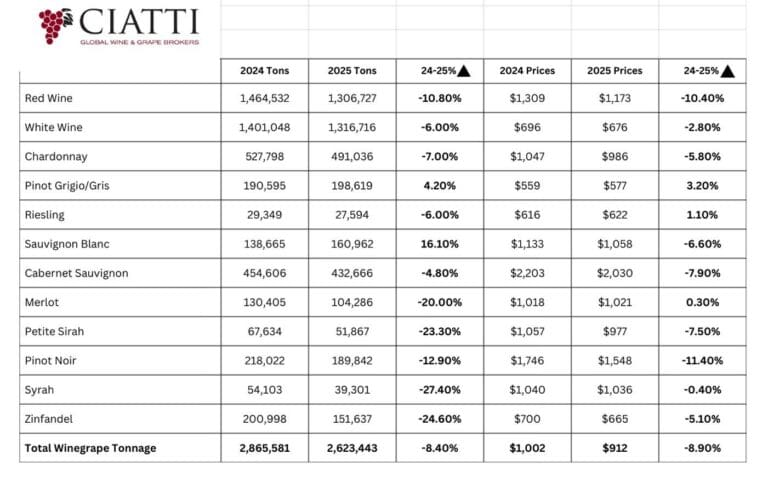
At approximately 2.6 million tons, the 2025 crush came in higher than most had hoped, and, more importantly, higher than many believe the market actually needs.
The Facts: What the Crush Report Tells Us
Data released by the California Department of Food and Agriculture shows that the 2025 grape crush totaled approximately 2.6 million tons. That represents a decline of just over 8% from the prior year and marks the smallest crop since the late 1990s.
On the surface, that’s a meaningful shift. After several years where production consistently exceeded 3 million tons, supply is clearly beginning to respond.
But the details matter.
Key premium varieties such as Cabernet Sauvignon, Chardonnay, and Pinot Noir all declined, while certain white varieties, most notably Sauvignon Blanc, continued to grow. Regionally, the contraction was uneven, with larger bulk-producing areas seeing sharper reductions than some premium regions.
And then there is what the report does not fully capture: unharvested fruit.
Grapes left on the vine are not just a footnote; they are a signal. They indicate that the final crush number reflects not only what was grown, but what the market was willing, or unwilling, to take.
So while the number is down, it is important to recognize what is driving that decline. This is not purely a supply-side correction. It is also a demand-driven constraint.
What It Means
Market commentary from Ciatti Company helps clarify the implications.
Image source - Ciatti
The smaller crop is a step in the right direction, but it does not resolve the underlying imbalance. The presence of unharvested fruit reinforces that demand remains constrained and that supply, in many segments, continues to exceed what buyers are prepared to absorb.
This distinction is critical.
A lower crush driven by reduced yields would suggest a tightening market. A lower crush influenced by demand limitations tells a different story. It suggests the system is still working through excess supply.
From a practical standpoint, the market remains soft. Bulk wine is still available, buyers remain selective, and pricing, particularly outside the premium segment, continues to face pressure.
For wineries, this means the window for opportunistic buying is not closing anytime soon. If anything, it may widen if supply does not contract more aggressively.
The Bigger Picture
To understand why this is happening, it is necessary to step back from a single vintage. Insights from the Silicon Valley Bank Wine Division consistently point to a structural issue rather than a short-term cycle.
U.S. wine consumption has plateaued and is likely declining in key segments. At the same time, the industry expanded production capacity during stronger demand years. The result is a system capable of producing more wine than the market now requires.
This imbalance takes time to correct.
Inventory built over multiple vintages must be worked through, and supply must remain below demand for a sustained period to restore balance. A single smaller crop, even one that is historically low, is not sufficient to achieve that on its own.
The tone coming out of the Unified Wine & Grape Symposium reinforces this reality. Vineyard removals are increasing, and there is growing recognition that the industry must adapt to a different demand environment. This is not a short-term adjustment; it is an ongoing realignment.
Why It’s Still Not Enough
Despite the progress reflected in the 2025 crush, several factors suggest it is not yet enough to bring the market into balance.
Inventories remain elevated, particularly in bulk wine, and continue to weigh on pricing and purchasing behavior. Demand has not stabilized, meaning supply reductions are working against a moving target. If consumption continues to soften, the level of production required for balance moves lower as well.
At the same time, supply adjustments are slow. Vineyard removals, replanting decisions, and contractual obligations all limit how quickly production can respond. There is also a degree of structural “stickiness”; once vineyards are farmed, the incremental decision to harvest becomes more justifiable, particularly if there is an opportunity to offset costs.
Finally, expectations themselves highlight the gap. Pre-harvest estimates across the industry generally pointed to a lower number, reflecting a broad understanding that deeper cuts were likely needed. The fact that the final crush came in higher suggests that, despite awareness of the issue, the system has not yet adjusted sufficiently.
Bottom Line
The 2025 crush is a step in the right direction.
But it is not a solution.
Production is declining, but supply still exceeds what current demand can sustainably absorb. The industry is in the middle of a multi-year correction, not at the end of one.
Until supply aligns more closely with demand and remains there for a sustained period, the market will continue to feel the effects of imbalance.
Protea works with wineries and select beverage businesses that want disciplined, dependable financial operations.
While our clients vary in size and structure, they share a common trait: they care about running better businesses and understand that accurate financial information is essential to achieving that goal.
Our goal is to help those who need and want better accounting make better decisions.
We typically support clients in one of three ways.
1. Full Accounting Department Support
For many wineries, we serve as the complete outsourced accounting function. We are their everything when it comes to accounting.
These businesses often:
Do not have internal accounting staff
Have outgrown informal bookkeeping
Realize they need reliable inventory costing and reporting
Want consistent financial visibility without building a full internal team
In these engagements, we manage everything from administrative support to day-to-day bookkeeping, inventory costing, financial reporting, and forward-looking financial insight. We operate as your accounting department, providing the structure and depth typically found in larger organizations.
This model is especially effective for growing wineries that need clarity and control but are not yet at a scale where hiring multiple in-house finance roles makes sense.
2. Integrated Role Within an Existing Finance Team
Some wineries already have an internal accounting resource but require additional depth.
In these situations, we may:
Fulfill the bookkeeper role, reporting to an internal controller
Serve as the controller overseeing an in-house bookkeeper
Provide financial management and reporting support that is not needed full-time
Assist with inventory costing and key close functionality
These clients are often more operationally mature but recognize that certain finance functions require specialized expertise. Rather than over-hiring or stretching internal staff beyond capacity, they partner with us to strengthen defined areas of their accounting structure.
3. Defined Function or Project-Based Support
For larger or more operationally established wineries, we may take on a clearly defined role within a broader finance team. We provide targeted support where capacity is constrained or where the business requires specialized expertise that does not justify a full-time hire.
This could include:
Accounts payable processing
Distributor billback capture
Payroll coordination
Specific reconciliations
Inventory costing
Financial reporting support
Many of these engagements begin as short-term coverage during staffing transitions—such as resignation, maternity leave, or unexpected absence- but often evolve into longer-term roles based on performance and fit.
We also support project-based work, including:
Accounting clean-up and reconciliations
Inventory costing corrections
Financial organization and support for due diligence
Assistance with sell-side transaction preparation
In each case, our role is clearly defined, structured, and aligned with the client’s broader finance function.
The Clients We Serve Best
Protea works best with wineries and select beverage businesses that are serious about strengthening their financial operations.
A partnership with Protea works best with owners and leadership teams who:
Value accurate, timely financial information
Want structured processes and consistent reporting
Are willing to engage and collaborate
View accounting as a strategic operational function, not just compliance
We are particularly effective with wineries navigating growth, operational complexity, staffing transitions, or increased financial scrutiny from lenders or stakeholders.
When We May Not Be the Right Fit
We may not be the right partner for businesses seeking:
The lowest-cost bookkeeping solution
Minimal communication or involvement
One-time transactional clean-ups without long-term structure
Our approach is disciplined and relationship-driven. We focus on building strong financial systems that support long-term success.