

Pour Now is hiring commission-only business development representatives. We're a small but growing team, and we now have over 500 brands on the platform. With so much more growth ahead of us, it's time to build our outbound sales motion, which is exactly why we are looking for hunters in this role.
Here's what you'd be selling: Alcohol beverage brands dedicate significant budget to marketing and, outside of DTC, cannot prove any of it drove sales to their accounts. Pour Now closes that gap. We aggregate live digital catalogs from more than 30,000 e-commerce-enabled retailers into shoppable Consumer Listings, so brands can see how much demand they drove and to which retail accounts. We're changing the story brands are using to maintain and grow placements. It's no longer "we spent marketing dollars in your market"; it's now "our marketing drove this many dollars in sales directly to your store last month for you to convert".
If you have supplier-side beverage alcohol sales experience, some exposure to marketing or alcohol beverage technology, and you are a hunter by nature, send a resume and a short note about your background to andrew@pour.now.
Business Development Representative at Pour Now, Inc.
The next piece in Pour Now's Insights series is for anyone who has sat through the DTC-versus-retail debate one too many times. Our cofounder and CEO Andrew Levy, who has spent twenty-five years on the commercial side of this industry, from the supplier tier to a digital marketplace to the investor's chair, makes the case that it was the wrong debate to begin with. He opens with a single number:
The same person who won't pay for shipping on an eighteen-dollar Tuesday bottle will spend seventy dollars on tequila [at their local store] without blinking on a Friday. Same customer. Different moment. Different money. That difference matters more than almost anything else in this business.
For wine specifically, he puts a hard figure on how much of the market DTC actually reaches:
Direct-to-consumer wine shipments run about $4 billion a year against $28 to $32 billion in total U.S. off-premise wine sales, or roughly 5% of the category, and wine is the easy case.
His argument is not that DTC is wrong or that the industry should stop investing there. It is that DTC is incomplete within the bigger picture: a purchase is driven by the moment a shopper is in rather than the type of channel customer they are, three-tier law quietly shapes the whole channel question, and omnichannel is coverage rather than compromise. He also gets specific about the part most brands skip, the measurement gap that keeps anyone from proving the lift, and what to do about it. The most important takeaway? Supporting omnichannel doesn't mean pulling back on DTC. It means capturing the sales DTC was never built to win, and having the right tools in place to prove it worked.
Read "DTC and omnichannel: an 'and' conversation" at launch.pour.now/insights/dtc-and-omnichannel.
Excerpts from a Pour Now Insights piece by Andrew Levy, cofounder and CEO of Pour Now.
Everyone in beverage alcohol has a theory about how shoppers buy, but very few have the data to prove it.
Today, Pour Now launched Insights, a new series where cofounder and COO Paul Mabray shares what two decades in the category, and a platform now working with nearly 500 brands, have taught the team about how alcohol shoppers actually move from wanting a bottle to buying one. It is a plain look at what works, what quietly breaks on the way to checkout, and what the data says about fixing it.
The opening pieces take direct aim at tools the industry has leaned on for years. "We Brought Receipts" lays out the measurable path to purchase the category has been missing, backed by real sales results instead of a vision deck. "The map is a dead end" argues that the store-locator map, after a decade and a fortune spent on it, is one of the worst-converting tools in alcohol commerce for all but a sliver of the market.
The throughline is the shopper. Where do they lose the thread between discovery and purchase? Why does intent leak out before it becomes a sale? And what does it take to convert that intent in the moment it exists, compliantly, without undercutting the retailers brands depend on?
New pieces will publish over the coming weeks, each grounded in what Pour Now sees across almost 30,000 integrated retailers and the shoppers moving through them. If you build, market, or sell wine and spirits, it is worth the read.
Read the series at launch.pour.now/insights.
Pour Now's cofounder, Paul Mabray, just published his first piece in nine months. This part is for anyone in the wine industry who has ever tried to guide their shoppers to buy online, only to cross their fingers and hope it worked. For years, the trail from interest to purchase has ended at a static list or map. Paul explains why plainly, then does the thing that matters most: instead of asking you to picture the fix, he tells you to go use it. In his words:
The reason it's so hard for alcohol beverage brands to succeed online is that there has never been a comprehensive, compliant, successful path to purchase.
He is just as blunt about what that has meant on the ground:
And so for years, "Where to buy" has been a dead end. A desert of maps, complicated networks of grey shipping methods, or marketplaces that consume our industry.
And then, rather than sell the vision, he hands over the keys:
Instead of telling you about a vision and asking you to imagine how it works, I can simply show you.
That is the part we would point every wine brand to. You really can click through the shopper experience yourself. Read Paul's full piece for the whole story, including the results behind it.
Read "We Brought Receipts" by Paul Mabray → click here
Excerpts from "We Brought Receipts" by Paul Mabray, cofounder of Pour Now, originally published on Transforming Wine.
We live in a world where distributed brands have to do real work to help customers find the best and right place to buy, wherever they are. The old answer was the “retailer locator”: a sad cluster of outdated pins on a map, with no genuine path to purchase and a short whitelist of stores that ignore the majority of retailers selling your product.
But in the U.S., most products don’t have clean, national-chain coverage. And most carting tools don’t have a multitude of smaller chains or independent retailers. So they do the expedient thing: when they can’t find a great retailer match, they default to marketplaces.
This may look convenient for shoppers and may feel omnichannel for the brand. But in practice, the customer pays fees and inflated prices while the brand’s marketing efforts are providing rocket fuel for marketplace growth.
This is brutal for retailers because marketplaces eat markets: they squeeze retailer margins while keeping customers for themselves.
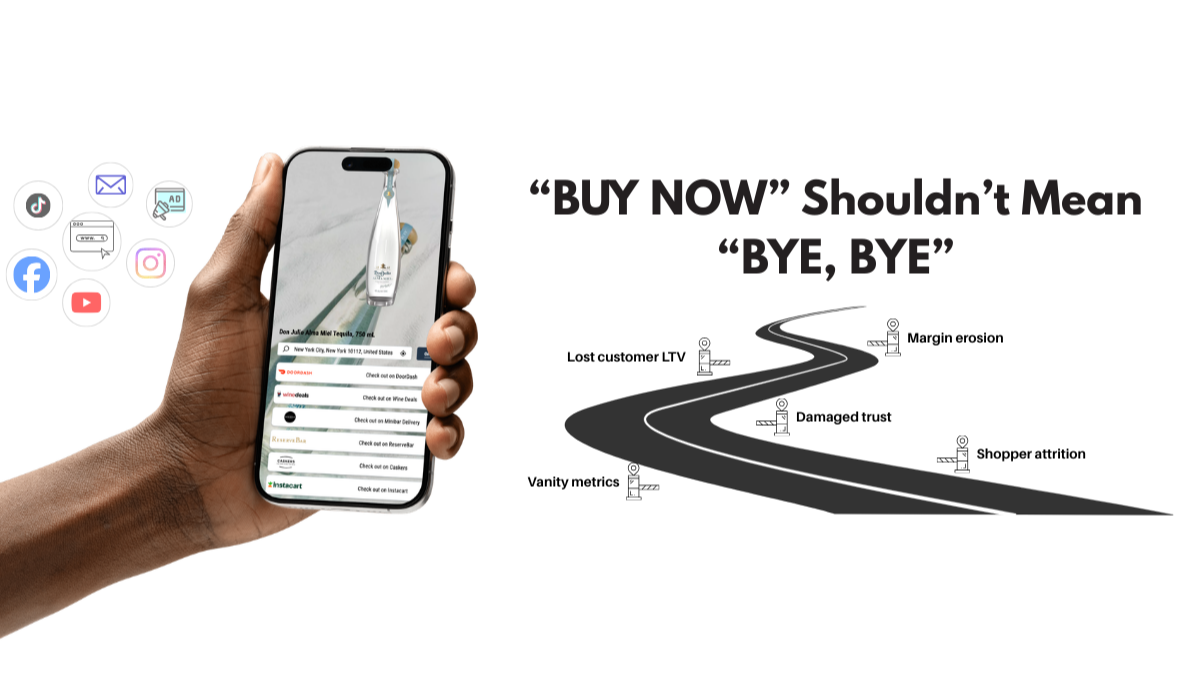
Meanwhile, we are actually paying to build the toll road that we have to pay tolls on! When our highest-intent shoppers are routed to marketplaces, we pay for attribution metrics and walk away thinking we have built a better path to purchase.
In fact, we have paid for the privilege of becoming a free affiliate, given away our retailers’ margins, and handed over the customer to a platform full of our competitors.
Here’s how it usually works
You build your brand and, through every possible channel, excite them to buy your products (your website, marketing, press, social media, or earned media). You pay a carting platform to give you “Buy Now” buttons. A shopper clicks Buy Now, and they get routed to a marketplace, typically Instacart, Uber Eats, DoorDash, ReserveBar, or Flaviar/Caskers, because this is the easiest way for these tools to claim “coverage”.
And then the marketplace collects the upside.
The marketplace gets the customer, not your retailer partner
The marketplace gets a percentage of the transaction, the email address, the purchase history, and the next touchpoint. They own repeat purchase behavior. They can cross-sell in-cart, recommend substitutes, and re-market that shopper the next time they open the app.
You get a report that says you “drove conversion.”
Your retailer gets a sale at a reduced margin and with no lifetime value because the customer relationship was not delivered to them.
You pay the carting platform to deliver and measure the shopper's transfer to the marketplace. And they tell you that only 8% to 15% of those shoppers complete the transaction (mostly because they don’t verify the marketplace's inventory availability by search location).
That isn’t omnichannel. It’s just a customer donation.
Carting tools didn’t create this tension, but they accelerate and exacerbate it, because the “path of least resistance” almost always points to the marketplace.
The path to purchase problem is real… but this isn’t the solution
Brands are right to demand attribution. You deserve to know which campaigns, channels, creatives, and partners are moving people from interest to purchase intent. But most importantly, shoppers deserve a REAL path to purchase.
Marketplaces have their place. By all means, use their ad networks and merchandising opportunities to grow demand for your product. But do it inside the audiences they built with their budgets. Don’t give them the audience you built with your budget.
The standard carting model is backwards
Carting solutions (and any shopper-journey platform) should prioritise one thing:
Helping shoppers to find and buy your products directly from both small and large retailers.
Do this, and your retailers will love you for it.