

Harvest Pillar is helping Cornell University take hop research to new heights.
Researchers at Cornell AgriTech are testing 61 hop varieties to find the ones that can thrive for growers, perform in the field, and ultimately make great beer. And this year, they’re adding something new to the experiment: a 21-foot trellis built with Harvest Pillar prestressed concrete posts donated by Jensen Infrastructure.
Cornell’s traditional trellises are 18 feet tall, but some hop varieties grow beyond the top wire. The new Harvest Pillar system will help researchers study whether going higher can increase yields and whether those gains make sense for growers.
It’s exactly the kind of work Harvest Pillar was made for: helping growers build for today while testing what’s possible tomorrow.
And we’re growing, too. The same durable concrete posts used for hops, vineyards, and orchards are now expanding into agricultural, commercial, and residential fencing to bring a long-lasting alternative to traditional wood and steel posts to even more applications.
We’re proud to play a small part in research that could benefit hop growers, brewers, and beer lovers for years to come.
From the hop yard to the fence line, we’re excited about what grows next.
Read the full story from Cornell here: https://news.cornell.edu/stories/2026/09/hops-and-dreams-cornell-helps-new-varieties-go-field-glass
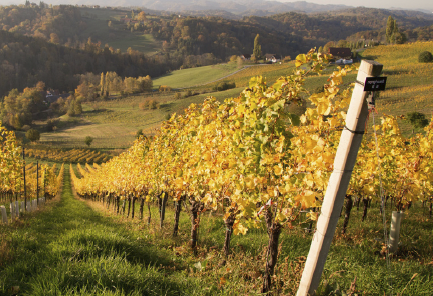
Mechanical harvesting has become an essential tool for many vineyards, helping address labor shortages and improve harvest efficiency. But repeated equipment passes and heavy crop loads can place significant stress on traditional trellis systems.
Prestressed concrete trellis posts are engineered with flexibility and strength in mind, allowing them to better withstand the demands of modern vineyard operations. Combined with resistance to pests, decay, and corrosion, durable infrastructure can help growers spend less time on repairs and more time focusing on vineyard performance and fruit quality.
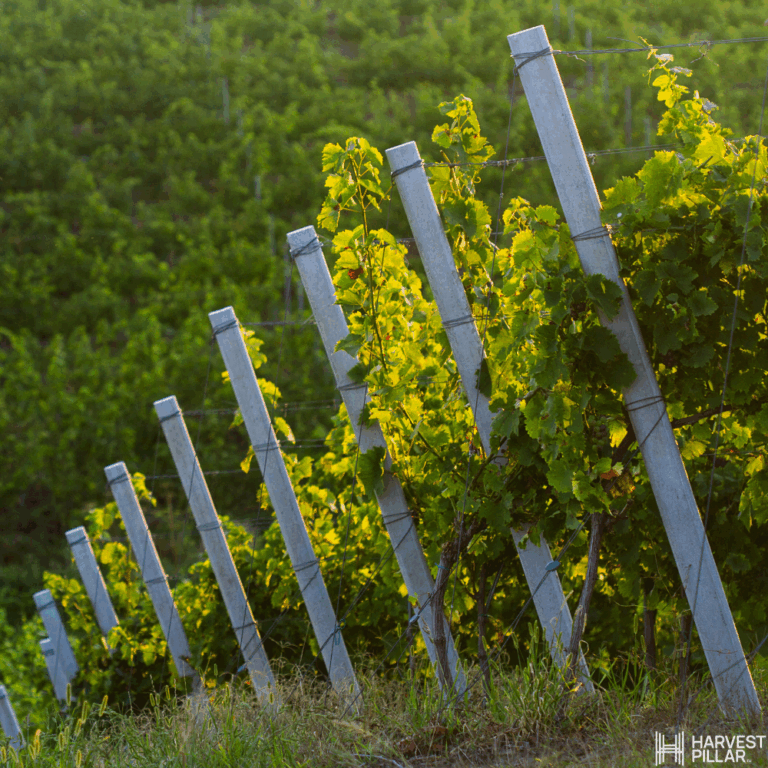
Wood has long been the standard for vineyard trellis systems, but growers today face increasing pressure to manage labor costs, improve efficiency, and maintain productive vineyards for decades to come.
Concrete trellis posts offer several advantages over traditional materials. They are naturally resistant to pests and disease, do not rust or corrode, and maintain their structural integrity through hot summers, winter storms, and repeated mechanical harvesting. With posts that can be spaced farther apart in many applications, growers may also find opportunities to reduce the number of posts required per acre while building a trellis system designed to stand the test of time.
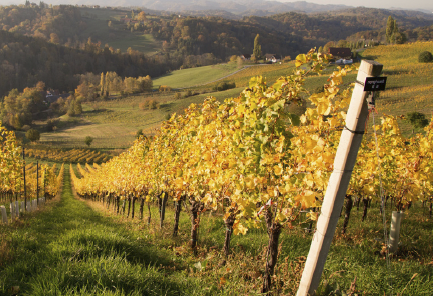
Vineyard managers spend considerable time evaluating vines, irrigation systems, and equipment, but trellis infrastructure often receives less attention until problems begin to emerge. Rotting wood posts, rusting steel, and repeated repairs can quietly increase maintenance costs and labor demands over time.
Concrete trellis posts offer a different approach. Designed to withstand heavy crop loads, mechanical harvesting, pests, disease pressure, and changing weather conditions, prestressed concrete posts can provide long-term stability while reducing the need for replacement and repair. For vineyards focused on maximizing the lifespan of their infrastructure investments, selecting materials designed for durability may deliver savings well beyond the initial installation.
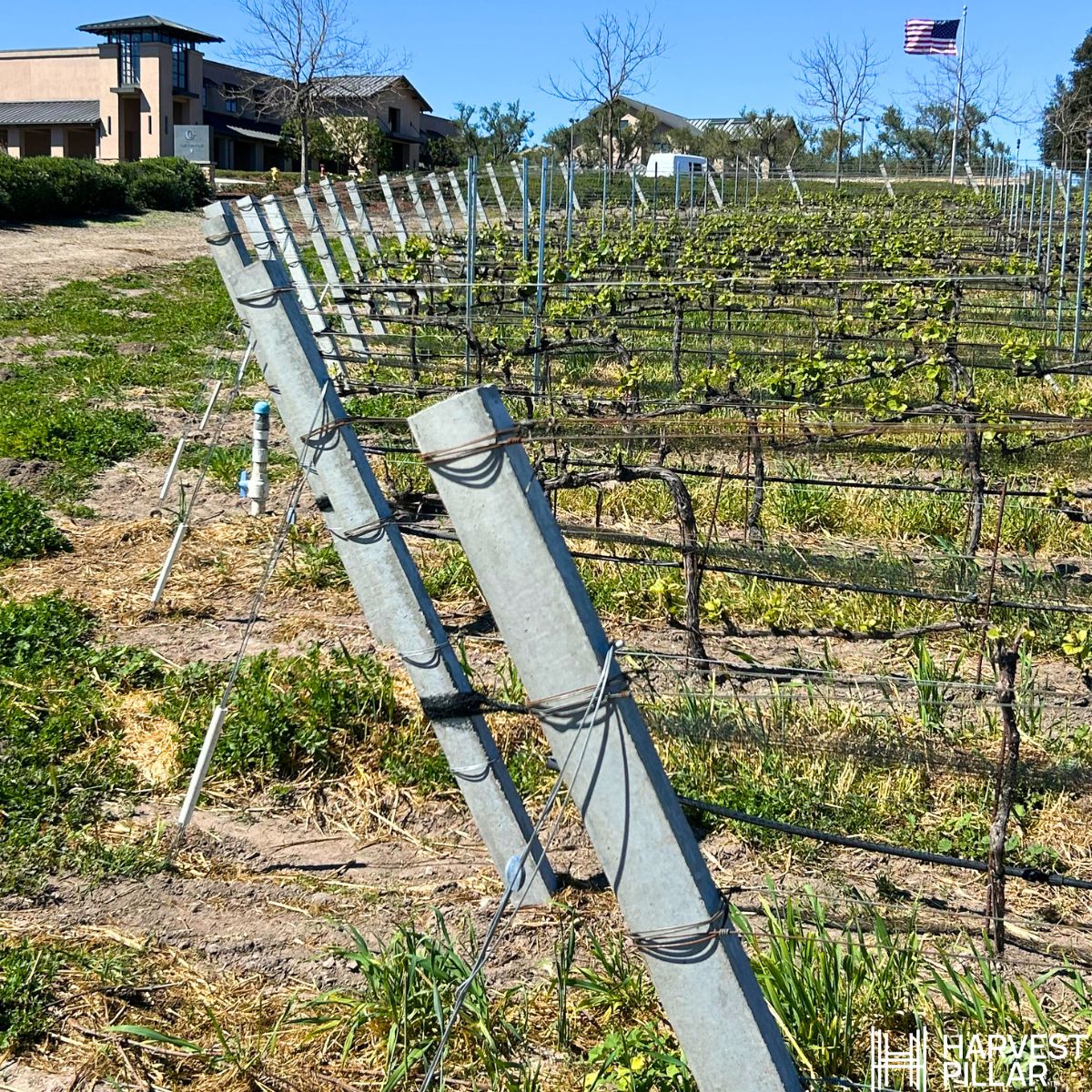
Another grower made the switch to Harvest Pillar.
At a winery in Arroyo Grande, California, roughly 700 of our beefy 4"×4" posts now anchor grape rows across the vineyard.
No rot. No warp. No replacement cycle.
Just a trellis post built to last as long as the vines it supports.
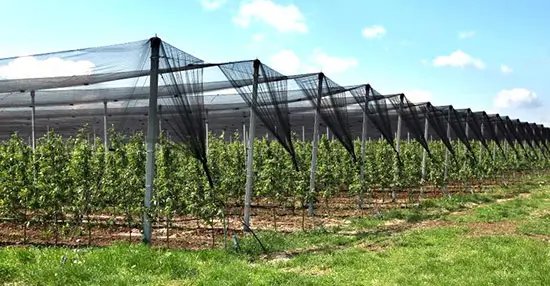
As vineyard owners adapt to record heat waves, canopy management and climate-mitigating techniques are front and center, but the real unsung hero might be the trellis system itself.
Temporary fixes can only go so far when the foundation isn’t strong. That’s why growers are rethinking traditional wood and steel posts in favor of long-lasting alternatives like concrete vineyard posts, which offer the durability and strength needed to support climate-adaptive tools such as shade canopies.
In extreme weather, - heat, wind, or even wildfire-prone regions - concrete posts outperform conventional materials. They’re fire-resistant, pest-proof, and strong enough to withstand the tension of netting systems without bending or warping. With the right anchor configuration, they can also be adapted to various terrain and row widths, giving growers more flexibility as their needs evolve.
When combined with shade netting, concrete posts offer a stable infrastructure that lowers fruit zone temperatures and improves berry development, all while reducing the labor and replacement costs that come with traditional post materials.
In a time when the wine industry is being forced to adapt fast, investments in infrastructure are no longer just about convenience; they’re about resilience. The right trellis system doesn’t just hold up vines; it holds up your business.
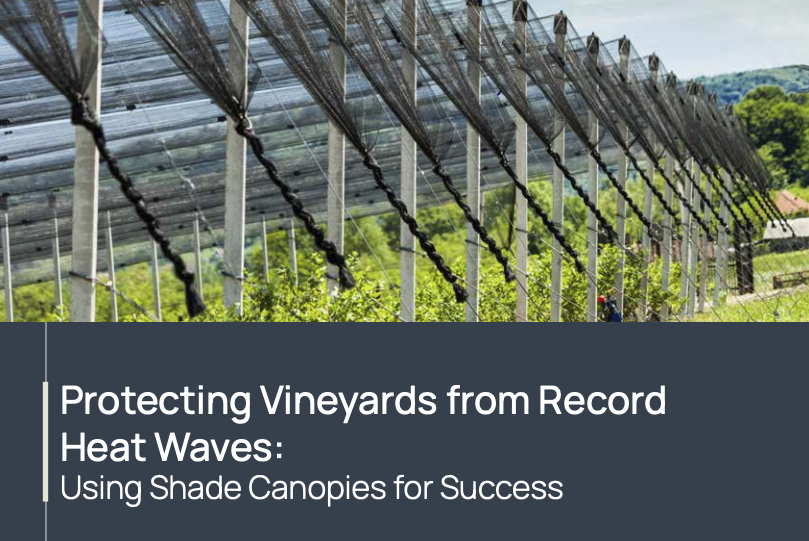
When a heat wave hits mid-season, vineyard managers face a tough choice: risk sunburned grapes or pick too early and sacrifice flavor development. But there’s a third option gaining momentum - shade canopy systems.
Shade canopies are proving to be a powerful tool in protecting fruit integrity during heat spikes. Research out of UC Davis shows that these overhead mesh structures can reduce sun exposure by 30-40% and lower the fruit zone temperature by up to 12°F. This seemingly simple strategy has profound benefits:
• Less shriveling means higher yields
• Improved anthocyanin and color development
• Better pH stability and titratable acidity
• Reduced irrigation demand
For growers, this translates to grapes that reach maturity without the stress-induced imbalances that compromise flavor, aroma, and longevity in wine.
Even better, these systems don’t require a complete vineyard overhaul. Many can be retrofitted onto existing infrastructure with minimal investment, and some innovative options, like the Harvest Pillar system, pair shade netting with durable concrete posts that stand up to wind, labor, and repeated installation cycles.
With climate pressure mounting each year, shade canopies are quickly shifting from an experimental strategy to a standard of smart vineyard management.
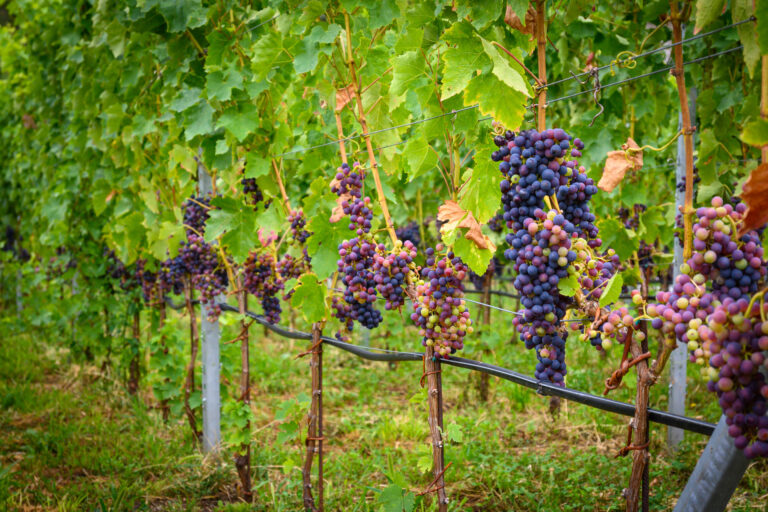
As climate extremes become more frequent, record-breaking heat waves are no longer rare events—they’re part of the new normal. For vineyard owners, the impact is immediate and severe: grapes shrivel, acid levels plummet, and fruit quality suffers. But while we can’t control the weather, we can adapt. Recent studies from institutions like UC Davis confirm what growers are seeing firsthand—heat spikes during the growing season have a direct and measurable impact on grape physiology. That translates to early harvesting, unpredictable flavor profiles, and rising losses due to sunburn and dehydration.
So, how do you protect your vineyard from the next heat wave?
Shade canopies are emerging as one of the most promising solutions. Acting like a sunscreen for your vineyard, these lightweight mesh structures reduce ambient temperatures around the fruit zone by up to 12°F. The result? Grapes with better color retention, reduced shriveling, and higher yields—without compromising Brix levels or pH balance.
We’re entering a new era in vineyard management, where resilience isn’t just a buzzword—it’s essential to survival. As we explore innovative strategies like shade canopies, there’s a growing need to rethink vineyard infrastructure from the ground up.
If you're a farmer or rancher who's had their eye on Harvest Pillar but wasn't ready to pull the trigger. Well, we got great news.
If you place an order online using promo code LK20, you will receive 20% off your entire purchase, no matter the amount.
Concrete posts, suitable for fencing and trellising, are a great option for folks tired of replacing their wood and steel posts every few years.
Harvest Pillar is the last post you'll ever need.
Check out our shop to get your first order started today: https://lnkd.in/gz2nGnPm
California State University, Fresno has a 1,000-acre farm near its campus that doubles as a classroom and laboratory. Which makes sense, located smack dab in the heart of California's fertile Central Valley, Fresno State is situated where 40% of America's fruits and nuts are grown.
At the Fresno State Jordan College of Agricultural Sciences and Technology, they grow grapes, nuts, seasonal vegetables, stone fruit, olives, and more on that 1,000-acre plot. Providing students with hands-on experience while testing and researching the latest technologies and innovations.
So, when it came time to replace aging chemically treated wood posts at their olive orchard, they figured why not give Harvest Pillar a try.
Concrete is a great alternative to chemically treated wood posts and steel. Harvest Pillar is more durable, weather-resistant, and doesn't need to be coated with harmful chemicals to increase longevity.
Click here to learn more about a better way to trellis: https://lnkd.in/gNSa7ZyS.