


Is your sales forecasting leaving money on the table?
Sales forecasting problems in beverage alcohol don’t always look like forecasting problems.
Imagine shipments are up 7%. On the surface, that’s good news. But a few months later, distributor inventory is high, the warehouse is filling up, and the next shipment forecast needs to come down.
What happened?
The shipment forecast may have been telling a different story than the depletion forecast.
That disconnect is worth paying attention to because, in BevAlc, shipments and depletions tell us two different things. Shipments measure what leaves the winery, distillery, or brewery and goes to the distributor. Depletions measure what distributors actually sell through to retailers and accounts.
Shipments may represent revenue today, but depletions provide an important signal of what the market is actually pulling.
When forecasts drift apart
At many beverage alcohol companies, depletion and shipment forecasts are built separately. Sales develops a depletion forecast based on what teams are seeing in their territories, while supply planning develops a shipment forecast to support production and inventory decisions.
When those forecasts aren’t systematically connected, they can gradually drift apart.
That can create downstream problems:
Production may plan against shipment expectations that don’t reflect changing market demand.
Inventory can build on SKUs that have slowed while faster-moving products become constrained.
Finance may add buffers because confidence in the forecast is low.
Sales teams can spend significant time updating forecasts without seeing how their input affects the broader plan.
The cost doesn’t necessarily appear on the P&L as a line called “forecasting error.” Instead, it can surface through excess inventory, emergency freight, margin pressure, missed targets, or missed opportunities.
The spreadsheet problem isn’t really about spreadsheets
Spreadsheets can be perfectly useful planning tools. The challenge begins when a collaborative forecasting process depends on emailing, merging, reconciling, and maintaining multiple versions of them.
If different teams are working from different versions of the forecast, determining which number is current becomes part of the job.
More importantly, by the time everything is consolidated, the underlying demand signal may have already changed.
A better forecasting process should make it easier for current market information to flow into the decisions that depend on it.
Three warning signs to watch
A quick check of your current forecasting process can reveal whether shipments and market demand are becoming disconnected:
Shipments are growing, but depletions aren’t keeping pace.
That may indicate inventory is accumulating downstream rather than being pulled through by the market.Shipment and depletion forecasts live in separate files or processes.
If there’s no systematic connection between them, discrepancies can persist until they become inventory or revenue problems.Sales, finance, and operations are planning against different numbers.
Different functions will naturally look at demand from different perspectives. But the business ultimately needs a reconciled plan everyone can execute against.
From forecast to executable plan
The goal isn’t simply to produce a more accurate spreadsheet.
It’s to create a forecasting process where depletion expectations inform shipment requirements, inventory positions are considered, and sales, finance, and operations can work from a connected view of the plan.
When that happens, a forecast becomes more than a number to review at the end of the month. It becomes something the business can actually use to make production, inventory, financial, and sales decisions.
Want to go deeper?
This is just a starting point. In the full article, we take a closer look at how disconnected shipment and depletion forecasts can affect inventory, revenue, and planning decisions, along with practical ways beverage alcohol companies can build a more connected forecasting process.
Continue reading on the Claret website:
https://claret.app/blog/is-your-sales-forecasting-leaving-money-on-the-table
If you’d also like to estimate what improvements to your planning and forecasting processes could mean financially for your business, try our free ROI calculator:
https://claret.app/roi-calculator
The complete guide to beverage alcohol planning
Over the years, we've written about forecasting, inventory planning, production planning, crop supply planning, and Sales & Operations Planning (S&OP).
But we kept coming back to the same observation.
There are plenty of resources that explain individual parts of the planning process, yet very few that show how they fit together. We wanted something that combined a bird's-eye view of the entire planning process with practical examples that reflected the way beverage alcohol companies actually operate.
So we wrote it.
The Complete Guide to Beverage Alcohol Planning brings together the major planning disciplines into a single resource, showing how information flows across the supply chain, from forecasting demand through to long-term supply planning.
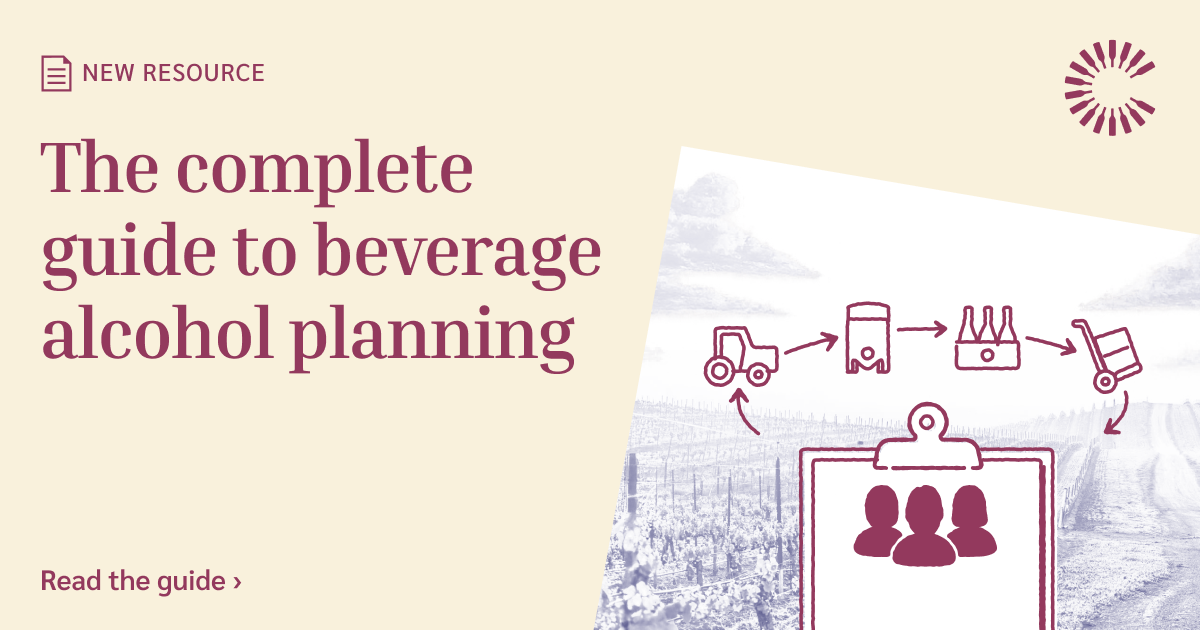
*From the guide: a visualization of the two flows every beverage alcohol company must manage
...
One of the most important concepts in the guide is that beverage alcohol planning consists of two connected flows.
The first is the physical flow of product. Grapes become bulk wine, bulk wine is bottled and packaged, finished goods are stored as inventory, and products are ultimately distributed and sold to customers.
Running in the opposite direction is the flow of planning information. Customer demand shapes the sales forecast, which determines inventory requirements. Inventory requirements drive production plans, and production plans define long-term supply needs for grapes, bulk wine, packaging materials, and other inputs.
At a high level, beverage alcohol planning answers four fundamental questions:
What do we expect to sell? Demand planning creates the sales forecast that becomes the foundation for every other planning decision.
Do we have enough inventory? Inventory planning highlights future shortages and excess stock, helping teams maintain service levels while avoiding unnecessary inventory.
What do we need to produce? Production planning translates demand into bottling plans, packaging schedules, and, for wineries, decisions about how much of each vintage should be made.
Will we have enough future supply? Long-term supply planning determines future requirements for grapes, bulk wine, packaging materials, and other critical inputs that often need to be secured months or even years in advance.
These planning disciplines don't operate independently. A change to the sales forecast can ripple through inventory targets, production schedules, vintage release dates, and future supply requirements. Rather than optimizing each planning function in isolation, connected planning helps businesses understand these relationships so they can make better decisions across the entire supply chain.
The guide explores each of these planning disciplines in more detail, explains how they connect, and provides practical examples from the beverage alcohol industry to help bring the concepts to life.
Claret is a planning platform built specifically for beverage alcohol producers. Throughout the guide, we've included examples and illustrations based on Claret's planning tools to show how these concepts can be applied in practice. The principles themselves aren't tied to any particular software. They're relevant to any producer looking to build a more connected planning process.
If you're new to beverage alcohol planning, the guide provides a structured introduction to the core concepts. If you've been planning for years, it's a useful reference for understanding how the different planning disciplines fit together. Either way, our goal is simple: to make connected planning easier to understand and easier to put into practice.
Read the full guide at:

Article preview:
S&OP tips: Engaging your Sales and Marketing teams
Sales and Operations Planning (S&OP) works best when sales, marketing, operations, and supply chain teams are aligned. But getting everyone engaged isn't always easy. Common challenges include competing priorities, limited time, communication barriers, and a perception that forecasting is "someone else's job."
A stronger S&OP process starts by:
• Building a collaborative culture across teams
• Aligning planning activities with business goals
• Providing training and clear accountability
• Encouraging cross-functional participation
• Demonstrating the value of better forecasting and planning
• Using tools that make collaboration easier
When sales and marketing become active participants in S&OP, companies can improve forecast accuracy, increase agility, reduce inventory issues, and make better business decisions.
Read the full article:
https://claret.app/blog/engaging-your-sales-and-marketing-teams
#SupplyChainPlanning #Forecasting #BeverageIndustry #BevAlc #SalesAndOperationsPlanning #DemandPlanning #SalesCollaboration #WineIndustry

Meet Claret at the Wine Sales Symposium
Next week in Sonoma 🍷 the wine industry comes together to talk growth, strategy, and what’s actually working in sales.
Claret will be at the Wine Sales Symposium, connecting with producers, distributors, and sales leaders navigating the same challenges we hear every day. From forecasting accuracy to aligning teams across the three-tier system, this event is all about improving how wine gets to market.
If you’re attending, it’s a great chance to meet the team and talk through how planning and forecasting can support stronger sales execution.
Event details:
📍 Sonoma, California Sonoma, California (DoubleTree by Hilton Sonoma Wine Country)
📅 May 2026
🎤 Wine Sales Symposium
👥 Focused on sales strategy, distributor relationships, and market growth in the wine industry
Get $20 off your registration with promo code CLARET2026 (details in the image)
Join us in Sonoma:
https://winesalessymposium.com/
Learn more about Claret:
https://claret.app/
#SupplyChainPlanning #Forecasting #BeverageIndustry #BevAlc #WineIndustry #SalesPlanning #ClaretSolutions

The decade bet: why spirits supply chain decisions in 2026 will define who wins in 2035
Spirits supply chain decisions aren’t just operational anymore—they’re long-term bets.
- What you decide in 2026 will shape:
- What inventory you’re sitting on in 2030
- Which brands you can scale (or can’t)
- How much working capital is tied up for years
- Whether you can respond when demand shifts
The challenge? Long aging cycles mean today’s decisions are locked in long before the market reveals what actually works.
That’s why leading spirits companies are shifting from reactive planning to long-range, scenario-driven strategies, connecting demand, supply, and capital decisions earlier than ever.
We break down what’s changing, and what it takes to stay ahead.
#SupplyChainPlanning #Forecasting #BeverageIndustry #BevAlc #SpiritsIndustry #LongTermPlanning #InventoryStrategy #DemandPlanning
Your BevAlc company is leaving money on the table. Here’s where to find it.
Money is leaking out in ways that are easy to miss:
- Excess inventory tying up cash
- Small stockouts quietly killing sales
- Teams spending hours reconciling spreadsheets
- Forecasts that don’t align across the business
Individually, these feel manageable. Together, they add up to a meaningful hit to margin.
The reality is that many wine and spirits companies are leaving money on the table—not because of a lack of strategy, but because planning is disconnected across sales, operations, and finance.
We break down exactly where that money is hiding—and how to start uncovering it.
Read the full article here:
https://claret.app/blog/your-bevalc-company-is-leaving-money-on-the-table
#SupplyChainPlanning #Forecasting #BeverageIndustry #BevAlc #WineIndustry #InventoryManagement #DemandPlanning #WineBusiness
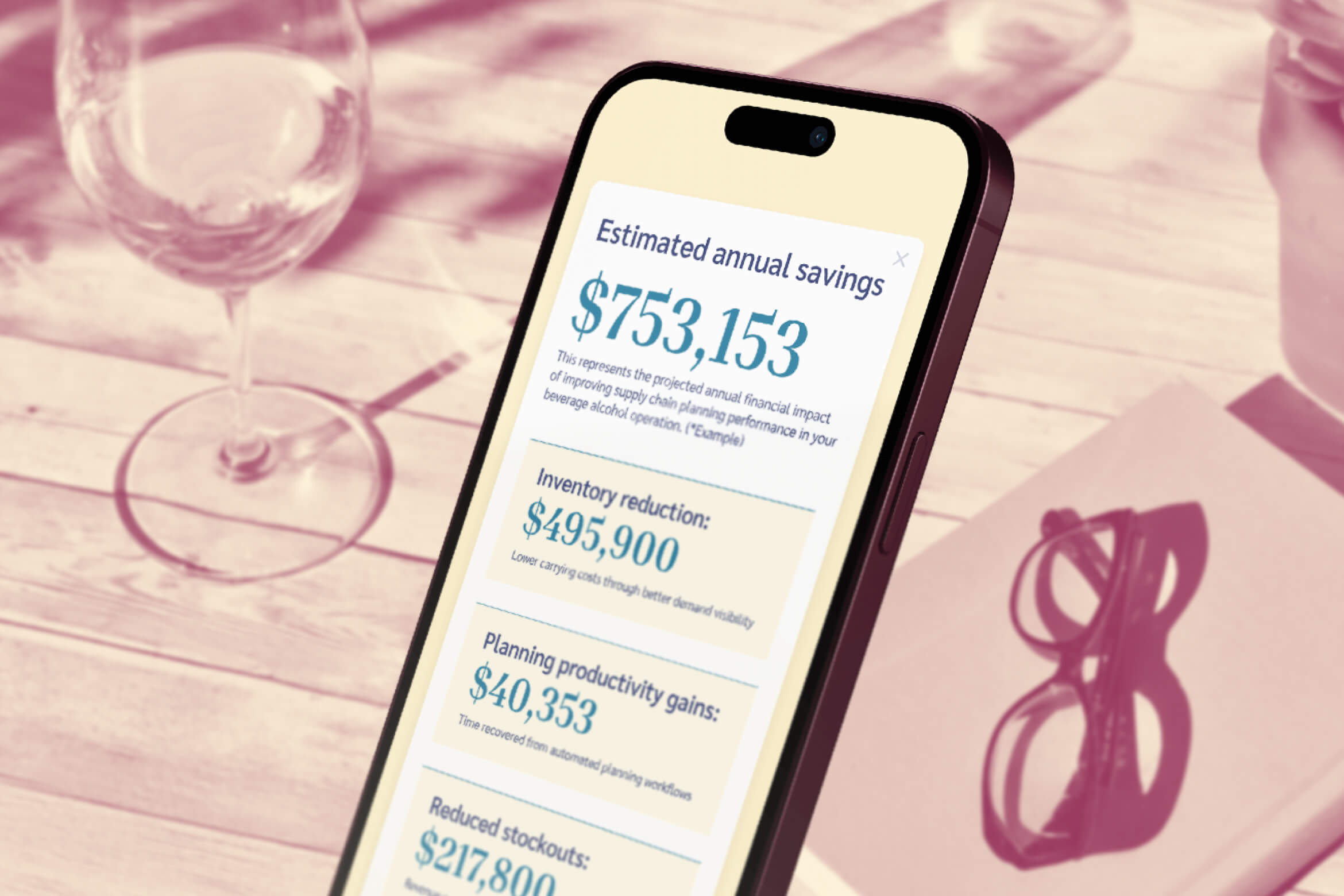
New resource: Beverage alcohol supply chain ROI calculator
How much is your planning process actually costing you? 🍷🧮
We just launched a free ROI calculator for beverage alcohol operators, and the numbers are eye-opening.
Excess inventory, planning hours, stockout losses. Most teams have a rough sense of these costs but rarely see them added up in one place.
We built a short calculator that estimates your potential annual savings across all three. It's based on conservative industry benchmarks and takes about two minutes.
If you're curious where your operation stands, check it out:
🔗 https://claret.la/roi-win

The origin story of Claret Profit Maximizer
We are sharing the backstory of the development of Claret Profit Maximizer.
Discover how our founder, Shawn Zizzo, leveraged his early career experiences and AI innovations to craft a service that revolutionizes wine blending by marrying traditional expertise with modern technology.
Read the full story here:
https://claret.app/blog/the-origin-story-of-claret-profit-maximizer
Join our founder and CEO, Shawn Zizzo, for a walkthrough of Claret Profit Maximizer.
In this video, Shawn goes through a demo of the model behind the service and shows how the outputs shine the light on how we can help maximize your profits while respecting label constraints, wine styles and more!
Discover how we combine expert insights with technology to help winemakers craft outstanding blends, tailored to their unique needs.
Learn more about our service at claret.app/profit-maximizer

Avoiding Stockouts: Strategic Safety Stock Calculation for Supply Chain Success
Effective safety stock calculation is key to navigating the unpredictable demand in the beverage alcohol industry. Master the essentials of maintaining optimal inventory levels and ensuring your shelves are never empty nor overly stocked.
Key formulas explained
Understanding safety stock is crucial for avoiding stockouts and managing excess inventory. In our article, learn the key formulas and data needed to calculate your safety stock accurately, ensuring that you always have the right amount of inventory when demand fluctuates.
Influencing factors
Factors such as forecast error, order size, and desired service levels play crucial roles in determining your safety stock levels. Our team expands on these concepts, providing detailed guidance on their practical application in inventory management. We also discusses how to use historical data and the Z value to fine-tune your safety stock levels for maximum efficiency.
Get the insights
Ready to enhance your supply chain skills? Read the full article for in-depth insights into safety stock calculations and how to apply them effectively in your operations.
https://claret.app/blog/avoiding-stockouts-strategic-safety-stock-calculation-for-supply-chain-success