

From vineyard to shelf: why winery plans work better together
Most wineries don’t struggle with planning because they lack data. They have plenty of it: crush reports, bulk inventory, case goods, depletions, sales forecasts, budgets. The trouble is that it lives in too many places. Each team keeps its own spreadsheet, each spreadsheet tells a slightly different story, and by the time everyone agrees on what happened, the business has already moved on.
Integrated planning is the practice of running those plans as one connected process instead of a set of separate ones. It isn’t new, but it matters more in wine than in most industries, and it’s easier to start than many teams expect.
Every plan depends on the one before it
A winery runs on a chain of plans:
Crop supply sets the limits on what you can make.
Sales forecasts shape how much finished inventory you need.
Inventory tells production what to bottle and when to release it.
Production drives a large share of what finance has to plan for.
Each link depends on the one before it. That’s what makes a disconnected setup costly: a change at one point has to travel along the chain, and in a spreadsheet world it usually travels by email, if it travels at all.
Here’s a common example. Sales trims the forecast for a key wine. The update lives in the sales team’s file. Production finds out weeks later, after the glass is ordered and the bottling date is booked. Nobody made a bad decision. They just made it with different numbers.
Signs your plans have drifted apart
If a few of these sound familiar, the plans in your business are probably running in parallel rather than together:
Multiple versions of the truth. Sales, operations and finance each walk into the meeting with a different number.
Late surprises. A shortage or an overstock shows up when it’s already expensive to fix.
Slow cycles. More time goes into assembling and reconciling reports than into deciding what to do.
Silos. Each department optimizes its own plan, not the plan for the business.
Distributor blind spots. Without good visibility into distributor inventory and depletions, it’s hard to tell real demand from shipments.
Why wine makes this harder
Generic planning approaches tend to assume short lead times and a steady supply of identical products. Wine offers neither. Decisions made at harvest play out years later. Every vintage is a different product with its own release timing. Much of your demand signal sits in distributor warehouses rather than your own. And seasonality affects nearly every part of the calendar.
That combination means a small disconnect early in the chain can grow into a large one by the time the wine reaches the shelf.
What integrated planning changes
When the plans are connected, every team works from the same data, and a change in one place shows up everywhere it matters. In practice, that tends to mean:
Less time maintaining spreadsheets and more time actually planning.
Inventory risks, supply constraints and forecast changes surface earlier.
More confidence in the forecast, because everyone has seen and agreed to it.
Faster responses when the market shifts, since you can test scenarios before committing.
Clearer visibility for leadership, without a week of report building.
Three ways to start, with or without new software
You don’t need to overhaul everything at once. Many wineries make real progress with a few habits:
Agree on one demand number. Pick a single forecast that sales, operations and finance all plan from, and make it the starting point for every other plan.
Set a regular planning rhythm. A monthly meeting where the teams review the same numbers together catches most drift before it becomes costly. This is the core of sales and operations planning (S&OP).
Bring depletions into the forecast. Planning from what consumers are actually buying, not just what you shipped, makes every downstream plan more reliable.
Where tools fit in
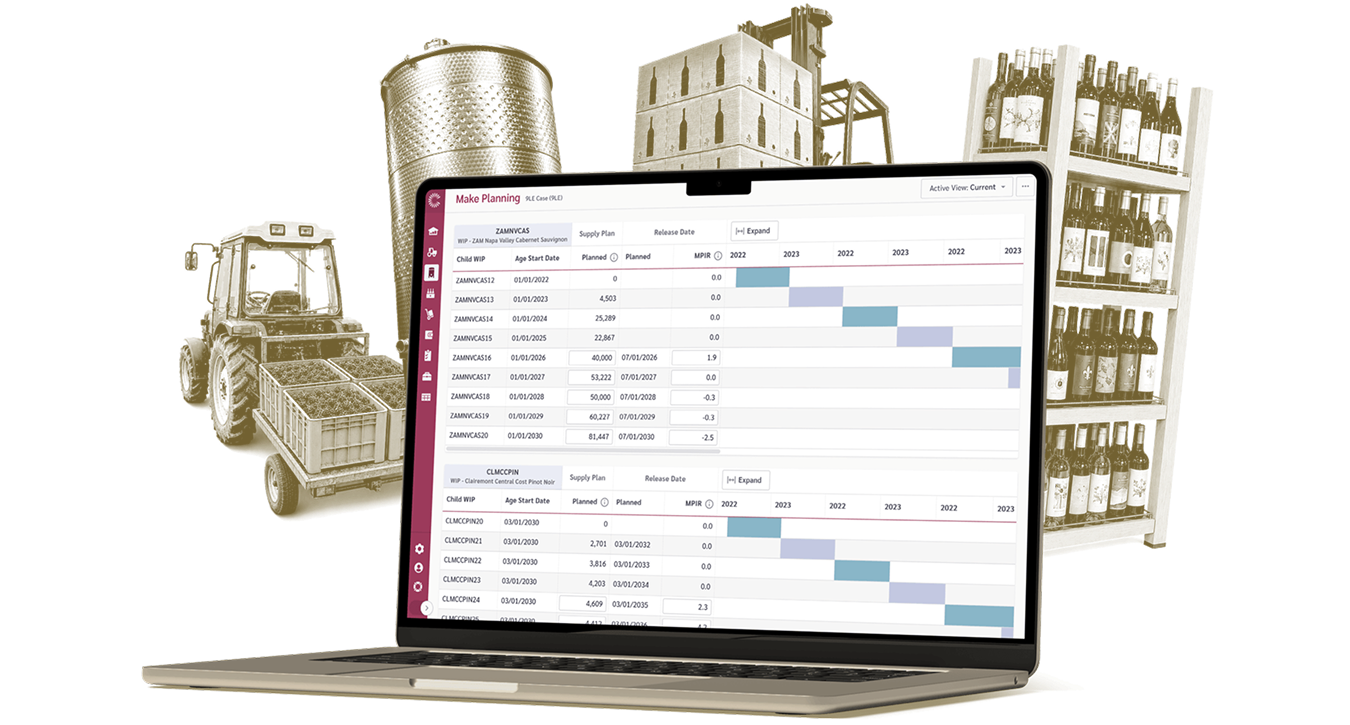
Habits get you started. At some point, though, keeping a chain of spreadsheets in sync by hand becomes the bottleneck. That’s the gap we built Claret to fill: a planning platform made specifically for beverage alcohol, connecting crop supply, make planning, inventory, distributor planning and sales collaboration in one place. Many teams start with the area that needs the most help and add the rest over time.
We’ve put together a fuller look at how integrated planning works across each stage, from crop supply to sales, along with what a short walkthrough with our team covers. You can read it here: Connected planning for beverage alcohol businesses .