

What does that mean for the vintage?
Budbreak came early to California this year, which by itself isn’t that strange. There are years when we’ve seen buds start to push by the end of February. But then what started as a warm February gave way to abnormally warm temperatures in March and early April. This accelerated phenological development even more. Traditionally, April 1st is the day when the count starts for growing degree days accumulation. But this year vines in many parts of the state already had more than a foot of growth by then, rendering this yearly measurement fairly useless as a comparison tool. By May 1st, I noticed bunch closure in a Central Coast vineyard…which in the words of the great Stephen Colbert, is just booboo banana bonkers.
So what does a crazy early start mean for the vintage? What can we expect and why am I …cautiously optimistic?
Water water everywhere…
In truth, the growing season for grapes starts well before any buds push at all. I’m talking about winter rainfall, or more importantly, late winter/early spring rainfall. In wet climates, this sets the stage for early growth but more importantly, the vines’ ability to reach water stress targets as we get into lag phase and veraison later down the road. Very wet years in the north coast on heavy soils with high water-holding capacity, don’t often dry out in time to get anything lower than a -6 on a pressure bomb. For varieties like Cabernet Sauvignon, you’re aiming for something closer to -13 by the time veraison hits. This year, the north coast got some high rainfall throughout the winter and into early spring. I therefore expect that some vineyards may never reach those target stress zones, especially if veraison hits a month sooner than expected.
Where I am in Paso Robles, rainfall is usually a small fraction of what the North Coast gets. We actually got upwards of 23 inches with a whopping 5 inches of it falling in mid-February. That’s a lot when you consider that this area is lucky to get 6 inches all year. And it shows! Central coast canopies that are normally skimpy and weak, depending solely on winter drip-irrigation in this part of the state look full. Rain always wets a much larger surface area (and hence soil volume) than do drip emitters, so both the hydric state and the nutritional state of these vineyards markedly improves in years that are wet, especially if canopy development is early enough to take advantage of it before the cover crop and gravity gobble it up.
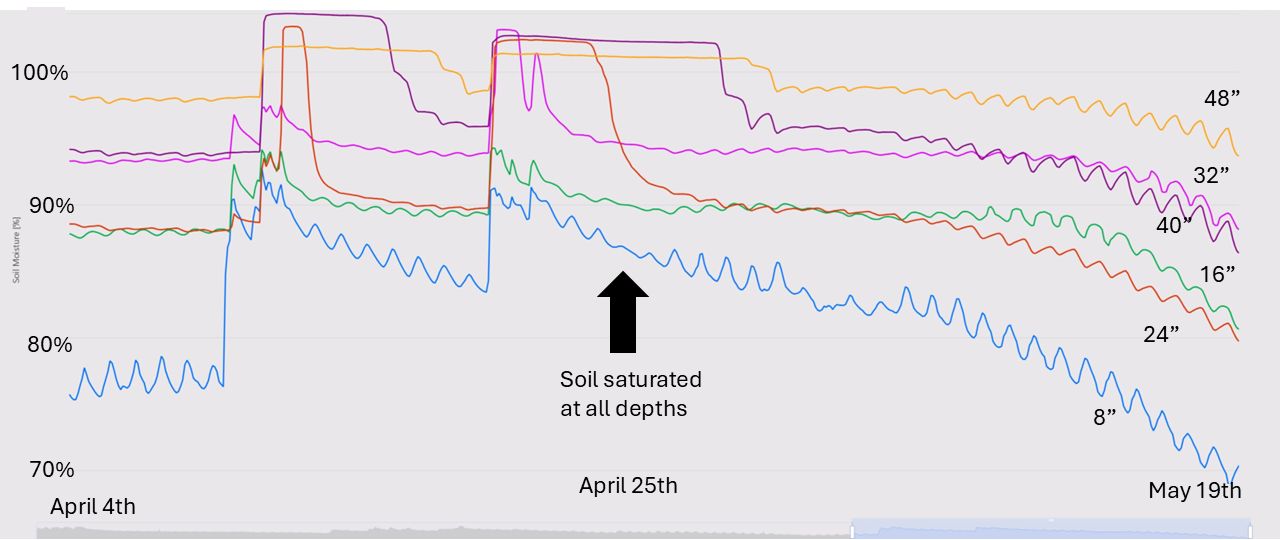 This Sonoma vineyard is on heavy soils. A saturation event in late April means this block may not dry out in time to adequately stress vines for quality.
Winter is coming…again
And then nature reminded us we were still in early spring, with temperatures dropping like a stone just in time for crop insurance…I mean flowering. Poor set, stuck caps and shatter are a common complaint up and down the coast. Unlike 2023, which was cool but late, low temps dipped for a week and if you were unlucky enough to be flowering during that time, you had poor fruit set. This year, primarily due to the precociousness of the season, a lot of fruit didn’t set as cool and wet conditions have stuck around for over a month.
In addition to poor set and shatter, we’re also seeing a lot of low fruitfulness. High temps during budbreak can cause low fruitfulness in buds, mostly due to the competition for assimilates from actively growing vegetation (Keller 2020). Keep in mind though that grape flower primordia form during bloom/fruit set of the prior season. Cool overcast temperatures during that period can lead to limited yield potential because primordia tend to form tendrils instead of clusters. Looking back on last year in late May and June, it doesn’t look like things dipped too low, at least not in areas where I’m seeing skimpy flowering this year. We certainly didn’t get cold enough in California for any winter-induced bud death. So maybe this year’s low fruitfulness can be attributed to a hot budbreak? Who knows? Some things don’t always make sense. Don’t look at me.
Anyway, poor fruit set and fruitfulness might be a benefit to growers overall as, we hope, wineries come out of hiding looking for fruit. (call us if you’re looking!)
The most obvious effect of the temperature drop off we’ve seen this spring is stagnating vegetative growth. Grape metabolism is optimal around 75-85° (25-30°C), so a sudden drop off in temperature means a reduction in photosynthesis and also reduced nutrient uptake, which is manifesting as short uneven shoots and apparent deficiencies in nitrogen and potassium. This is paradoxical since ample rainfall makes more of these nutrients available (Keller 2020). Apical tendrils are short and stunted, leading many to believe vines are water-stressed when in reality the soil is saturated at deeper depths or at least very moist and the vegetative growth just isn’t active enough to be tapping into it. Again, these weren’t a few cold days here and there. April was downright cold and wet. In high elevation coastal vineyards we saw weeks of temperatures where the high didn’t reach over 60° Fahrenheit. Growing Degree Days don’t accumulate if the average temperature is below 50° (10°C) meaning vine metabolism essentially stops. If your weather is normally variable, it’s abnormally super variable this year.
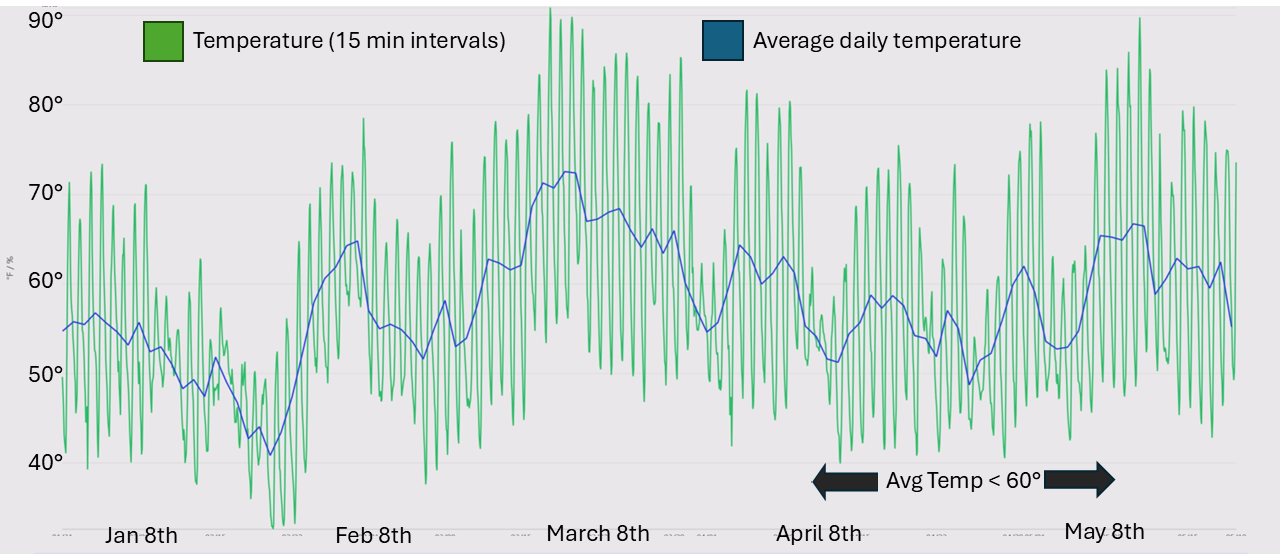 The above shows temperature from a West Paso Robles vineyard from Jan 2026 to today. Note the warm February and March temperatures and the cool April-May period, which slowed growth significantly at this vineyard as the average temperature didn't exceed 60° for a month. This was the case state-wide.
What awaits us?
Provided you can get through the spring with some crop left on the vine, an early season can be a favorable one. Places that usually get hit with high heat will be able to get through fruit set and into veraison before the typical mid and late summer heat waves hit. Post-veraison fruit is less susceptible to heat damage as well as smoke taint from wildfires later in the season due to the accumulation of anthocyanin and epicuticular wax respectively. For cooler vineyards, an early start and presumably fewer grapes means you can actually get your fruit ripe, which wasn’t a given in both 2023 and 2025. Places that struggle with water stress have ample soil moisture to work with and hopefully full reservoirs too.
September and October have been notoriously variable in recent years. Think 2022 with a late heat wave wiped out what was a decent vintage, or 2020 when the Glass fire…y’know what, we don’t need to relive 2020.
The one thing about an early season is that ripening grapes during longer, warmer days is going to further accelerate sugar accumulation. If you struggle to line up your physiological (i.e. sugar) and aromatic/color/mouthfeel ripening curves with phenolic development, this season may through us a curve ball. I mentioned that just getting to the right water-stress levels in time for lag-phase and veraison will be challenging if your soil holds onto water. It’s important to hit some level of water stress, at least in red varieties, prior to veraison in order to stimulate the phenolic ripening process. The other important factors in wine quality such as acid, aromas, and sugar accumulation are usually derailed by heat events exceeding 100° and 105°. The benefit of avoiding these heat events common in August and September outweighs the cost in my opinion.
And for my growers, aside from dwelling on the insane logistics of harvesting a bunch of fruit that’s all ripe at the same time, are y’all excited about having September off this year??
Keller, M. (2020). The science of grapevines. Academic press.