

The spreadsheet every cellar keeps open
It is 7 a.m. in the middle of harvest. Thirty ferments are going, and someone is walking the cellar with a clipboard or a tablet, taking Brix and temps tank by tank. Back in the office, those numbers go into a spreadsheet. Later that week, the same spreadsheet tracks a round of SO₂ additions across a few dozen barrel groups, then the topping schedule.
If that sounds familiar, you are not alone. Almost every winery we talk to, regardless of size or what production software they use, has a spreadsheet doing quiet, essential work somewhere in the cellar.
Why the spreadsheet wins, and what it costs you
The spreadsheet wins because it is fast. You see every tank at once, tab across a row, paste in a column of lab results, and move on. Nobody needs training.
The catch is that the spreadsheet lives outside your production system. Someone still has to carry those numbers into the real record, and every handoff is a chance for a value to be retyped wrong or never make it over at all. Meanwhile, anyone can overwrite a cell or delete a row, and there is no history to show it happened.
The result is that a lot of cellar work gets done twice: once in the spreadsheet, and again in the software. That double entry eats hours during the busiest weeks of the year, and it leaves gaps in the data your compliance reports and lot costing depend on.
The missing piece in winery workflow
Cellar work comes in two shapes, and good software needs a tool for each.
Some work is deep. A blend, a bond-to-bond transfer, or a bottling run carries real logic: volumes have to reconcile, tax classes have to follow the wine, and costs have to roll forward. That work belongs in a detailed, guided form that gets every piece right. Planning and assigning that work belongs in work orders, so the crew knows what is next and the winemaker knows what got done.
Other work is wide. Brix and temps across every ferment, an addition on forty barrel groups, topping the whole cellar. None of it is complicated, but it repeats across many lots, often every day. Pushing that through a detailed form one lot at a time is slow, and that is exactly why it ends up in a spreadsheet.
Forms and work orders handle the deep work well. What wineries have been missing is a way to do the wide work inside the system, with the speed of a spreadsheet. That is the piece we set out to build.
Meet Sheets in Blended
Sheets is spreadsheet-style data entry built directly into Blended, our winery production platform. It looks and feels like a grid. You pick the lots, tanks, or barrel groups you are working on, they line up as rows, and you tab across entering the day's work.
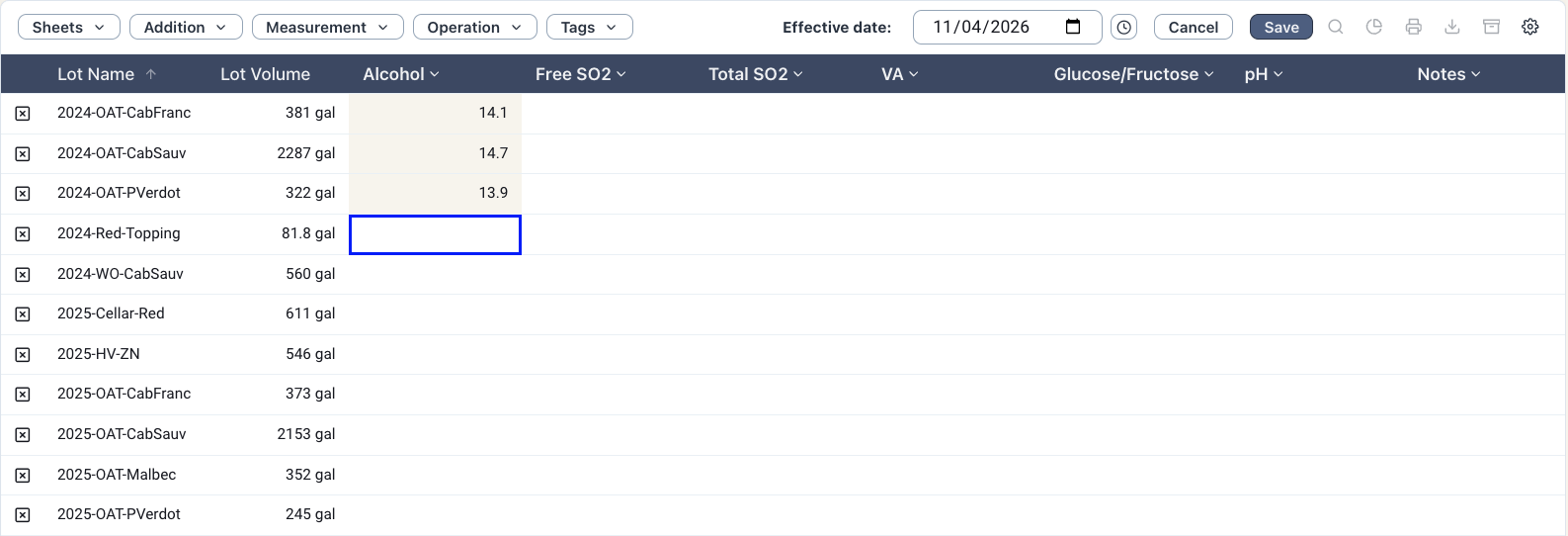
What makes it different is where the data goes. Every value you type writes straight into the system of record as a real, timestamped transaction, tied to the actual lot and vessel. There is no export, no import, and no retyping later. The moment the sheet is done, your lot history, compliance reporting, and cost of goods are up to date.
Sheets is live today in Production, where the wide work happens most:
Measurements like Brix, temperature, and lab panels across every ferment
Additions such as SO₂ or nutrients across many lots or barrel groups at once
Actions, tags, and tax classes applied in bulk
Topping across the cellar in a single pass
You can mix these entry types in one sheet, so a full morning round happens in one place. Save any sheet as a template and your daily routine is ready to go tomorrow. And when a task needs the depth of a guided form or the planning of a work order, those are right where they have always been. Sheets fills the gap between them.
See it with your own cellar routine
If part of your cellar still runs on a spreadsheet, we would love to show you what that same work looks like when it goes straight into the record. Bring your morning round or your weekly additions to a demo, and we will build the sheet with you live. Reach out to Hello@blendedtech.com to set one up.