

For wineries, inventory has never been quite as simple as the number of bottles sitting in the warehouse. But as DTC programs have expanded across ecommerce, tasting rooms, wine clubs, multiple locations and fulfillment methods, knowing what you have has become increasingly different from knowing what you can actually sell.
That distinction matters operationally, but it also matters for revenue.
A wine can show 500 bottles on hand while some of those bottles are already committed to online orders, others are reserved for an upcoming event or release, and still others may be sitting at a location that doesn’t supply the sales channel trying to sell them.
If every team is working from the same “500 bottles” number, the winery doesn’t really have inventory visibility. It has a physical count.
The Four Numbers Behind Better Inventory Visibility
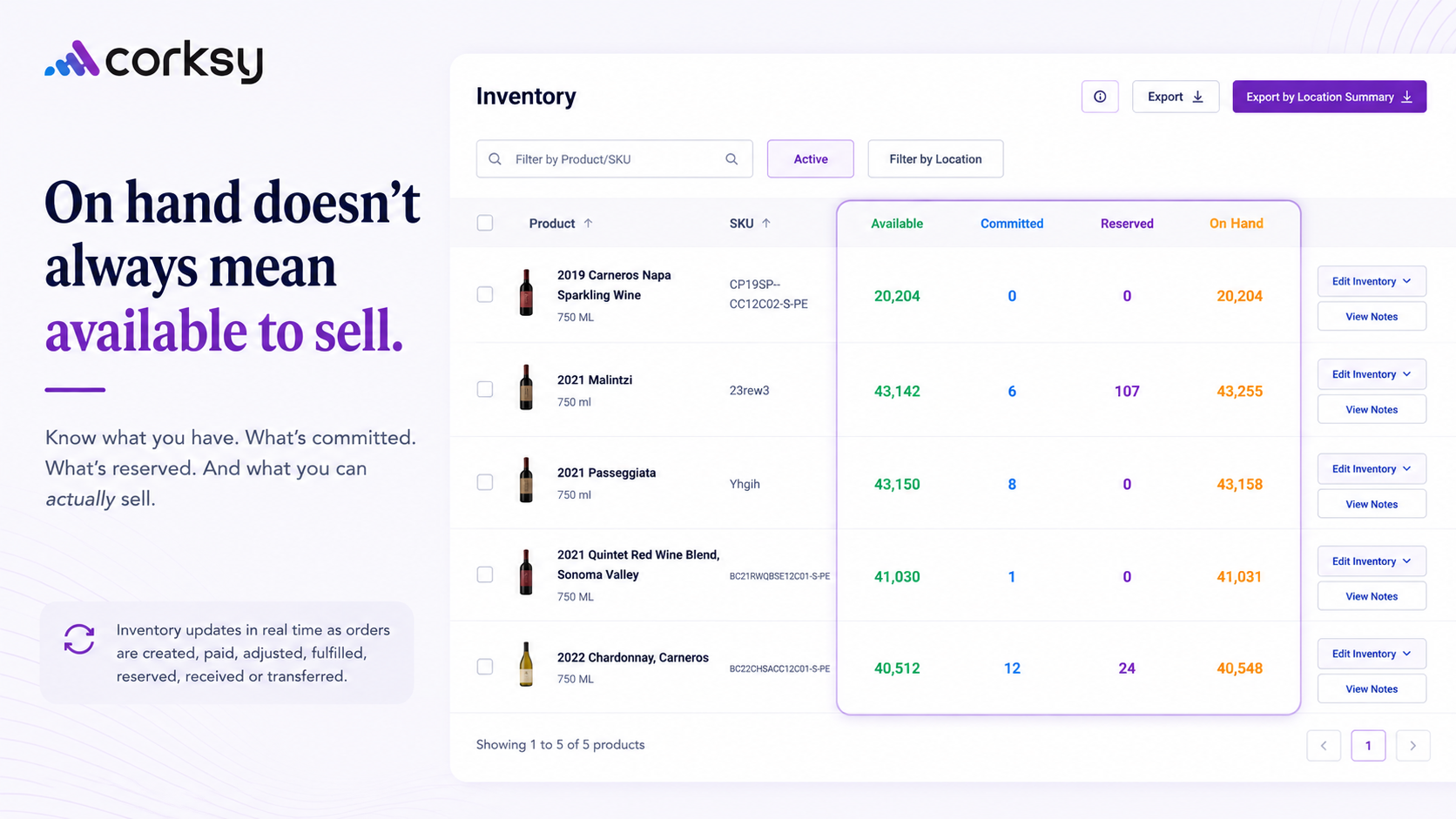
One useful way to think about modern winery inventory is through four different numbers:
Available: Stock that can be sold right now.
Committed: Stock that has been committed to an order but has not yet been fulfilled.
Reserved: Stock intentionally held back for a specific purpose, such as an event, club release or VIP.
On Hand: The physical inventory at a location — including Available, Committed and Reserved stock.
The distinction is important because a bottle can still be physically On Hand while no longer being Available.
A pickup order is a simple example. Once the customer purchases the wine, those bottles shouldn't remain available for another customer to buy. But until the order is picked up, they're still physically sitting at the winery.
In practice, that inventory follows a straightforward lifecycle:
Available → Committed → Fulfilled
If an order is canceled before fulfillment, that inventory can become Available again. Inventory intentionally held for another purpose moves between Available and Reserved without changing the physical On Hand count.
That's the model Corksy recently introduced across its inventory system, giving wineries a clearer view of what's physically there, what's already spoken for and what can actually be sold. Corksy's inventory statuses now update as orders are created, paid, canceled, refunded, fulfilled, reserved, adjusted, received or transferred.
 The concept itself is straightforward. The operational details are where it becomes important.
Wine Club Is Where Inventory Gets Particularly Interesting
Wine club adds another layer to the inventory equation.
Many wineries allow members to customize upcoming shipments, sometimes for days or weeks before a club batch is actually processed. Holding every bottle sitting in a member's customizable package as committed inventory throughout that entire period can unnecessarily reduce what appears available to sell elsewhere.
In Corksy, customizable wine club packages don't hold inventory while members are making their selections. Inventory becomes Committed when the batch processes and individual orders are created.
That does mean wineries need visibility into projected club demand before processing, particularly for limited-production wines. But it separates two very different operational questions: What might we need for an upcoming club run? and What inventory has actually been committed to an order?
The goal isn't simply to track more numbers. It's for the inventory behavior to reflect what's actually happening with the wine.
Inventory Visibility Is Also a Sales and Marketing Issue
Inventory management may primarily live with operations, but its effects reach directly into marketing and sales.
Consider a limited wine you're preparing to feature in an email campaign.
If the marketing or ecommerce team sees only On Hand inventory, the number may look healthy. But if a meaningful portion is already committed to orders or intentionally reserved, promoting that wine aggressively could create a problem.
The opposite can happen too.
When teams don't have confidence in inventory, the safest response is often to be conservative. A wine comes off the website early. Marketing avoids promoting it. Tasting room staff are told not to sell another case until someone checks with the warehouse.
Better inventory visibility creates more confidence to sell.
It can also help wineries understand where inventory can actually be sold. A winery may have plenty of a particular SKU overall, for example, but only some of that inventory may be accessible to its ecommerce channel.
Corksy's new Sellable by Channel report is designed around that question, showing available inventory based on the locations from which a selected sales channel can pull.
That's a much more useful DTC question than simply asking how many bottles exist.
Don’t Forget the Inventory That Has Already Sold
There's another category that can easily get overlooked: inventory that's been committed to a customer but hasn't finished its journey.
An ecommerce order may be paid and waiting to ship. A tasting room customer may have a pickup order waiting at the winery. An Admin order may have been created for a known customer but hasn't yet been fulfilled.
Those bottles are still physically On Hand, but they're no longer inventory the winery should be trying to sell.
And once inventory is committed, another operational question becomes important:
How long has it been waiting for fulfillment?
Corksy's new Pending Fulfillment report identifies orders with committed inventory that hasn't yet been fulfilled and groups them by how long they've been waiting. A separate Reserved Stock report shows what's being held, why it was reserved, who reserved it and when.
That turns inventory reporting into something teams can actually work from rather than something they review only when counts don't match.
A Better Inventory Question
Modern winery DTC is interconnected.
Wine club affects inventory. Ecommerce affects fulfillment. POS affects available quantities. Pickup orders can be sold while still physically sitting at the winery. Locations affect what each channel can sell. And all of it ultimately affects the customer experience and the winery's ability to generate revenue.
The technology supporting those channels should understand those relationships too.
That's the thinking behind Corksy's latest inventory improvements: give winery teams a clearer view of what's physically On Hand, what's already Committed, what's intentionally Reserved and what's truly Available to sell.
Because the most useful inventory question isn't always:
How much wine do we have?
It's:
How much wine can we sell?
Want a clearer view of inventory across your winery? See how Corksy connects inventory, ecommerce, wine club, POS and fulfillment →