

Most barrel room humidification systems mean plumbing the ceiling, pulling permits, and writing a check to your contractor before you've added a single point of humidity.
If you're leasing your production space, a plumbed humidification system is a tough sell. You're looking at tens of thousands of dollars in equipment and contractor work bolted into a building you don't own, and none of it goes with you when the lease ends.
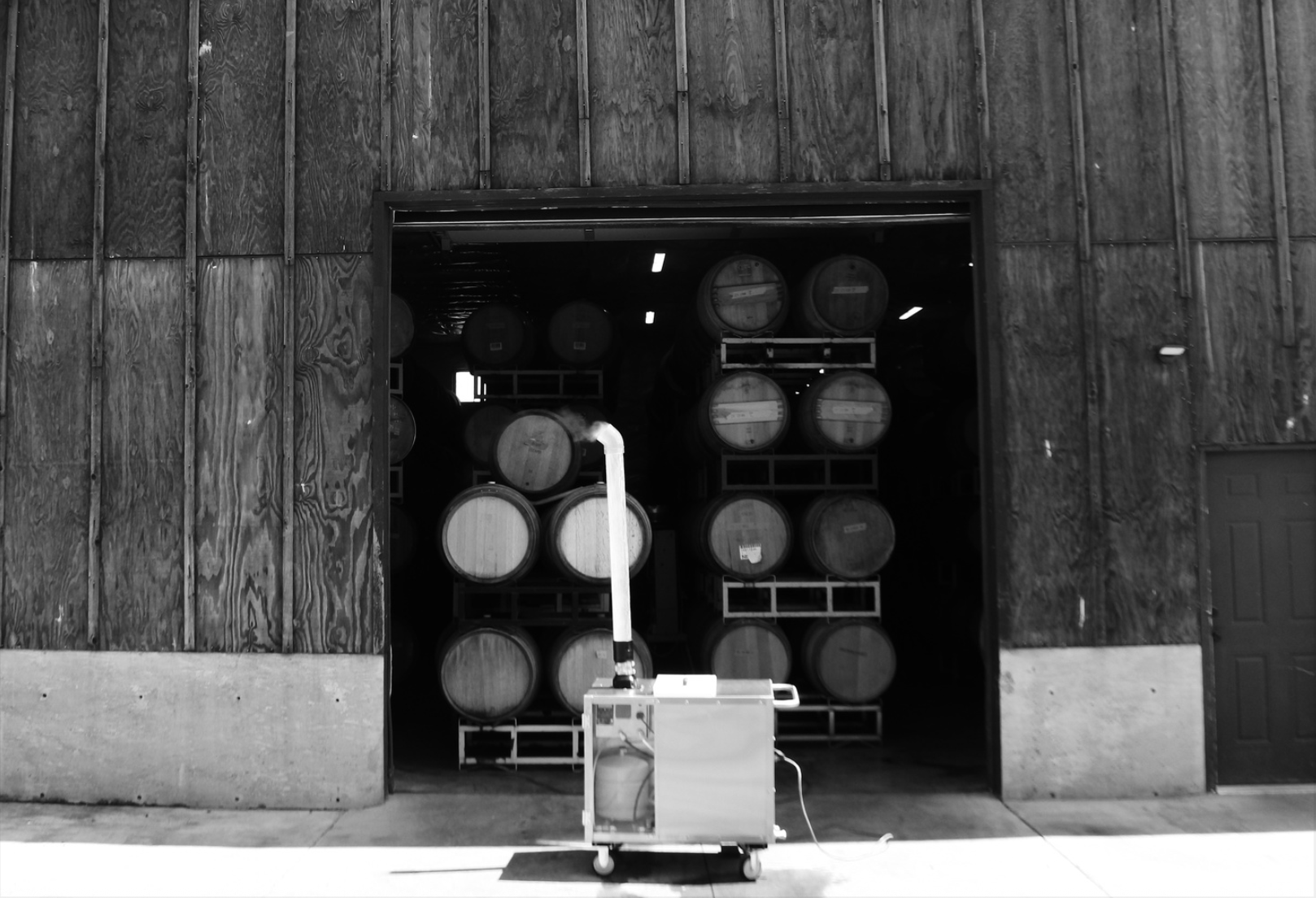
Dry Fog: Roll It In, Plug It In, Done
FreshTech's Guardian Angel Dry Fog units are available as cart-mounted and fully portable humidification stations. You roll one into the barrel room, plug into a standard 115V outlet, connect water to the inlet (garden hose thread inlet is standard), and it runs.
One properly-sized unit covers a large barrel room. No dealing with contractors, no pulling permits, no overhead plumbing required.
If the fog is needed elsewhere, roll it around. If your lease expires, load it into the moving truck.
Why Humidity Matters
For distillers, humidity controls how fast proof climbs as the barrel ages. Some "concentration" is expected, and even desired. But in extremely dry climates, water evaporates so much faster than ethanol that proof runs away from you, and barrel quality starts to deteriorate. Humidification gives you a dial you can control.
For winemakers, humidity controls topping frequency, ullage rates, and how hard the wood is working against you. A dry barrel room means more labor walking the racks, more wine going into top-up duty, and faster barrel degradation. Bringing humidity up flattens the topping curve, extends barrel life, and keeps wines from aging too "hot", giving you real control over what you bottle from barrels.
Either way, the angel's share shrinks (sorry, angels).
What is "Dry Fog"?
Don't call it a mister, mister. Dry fog is sub-2 micron particles (smaller than a red blood cell) that stay airborne as a rolling fog instead of falling out as droplets. These are the same units used by major operations like Costco for humidifying produce rooms.
Dry fog makes humidity you feel, not humidity you mop up. A normal system properly sized uses a few gallons of water a day, even in large rooms.
Traditional misters use high-pressure pumps to push water through nozzles, generating large droplets that hit the floor. That's why they need plumbing, drains, and a lot more water and power, and why they often clog. With dry fog, there is nothing to clog.
Dry Fog has Serious Side Benefits
The same unit can dose adjuncts into the fog for other jobs:
Hydrogen peroxide for full 3-D room sanitization, reaching all surfaces
Pyrethrin for fruit fly control
Chitosan for combatting Brettanomyces
Any liquid product you would normally spray or scrub can likely be "fogged" with equal efficacy
And while most humidification systems work against your A/C, ultrasonic fogging works with it, helping reduce energy costs. Ultrasonic fog promotes adiabatic cooling from the evaporating fog, which also typically drops ambient temperature 5-10 °F using minimal power.
Two Configurations
For the cost-conscious, shelf-mount units start under $10K for humidification only. Place it on a shelf out of the way and set your desired humidity %. It does the rest. These are the same units Seguin Moreau uses in their French cooperage for barrel storage and humidification.
For those who want flexibility, the cart-mounted version adds onboard water filtration and adjunct dosing, and rolls anywhere you need it.
See One Run In Your Barrel Room
TCW has a demo unit available for customers in Napa, Sonoma, or Mendocino counties. We'll bring it out and run it in your space so you can see what it actually does before you commit to anything.
Outside those counties, we can send specs, photos, and video, and talk through sizing for your room.
Click the Send Me Info button below or call (707) 963-9681 to get started.